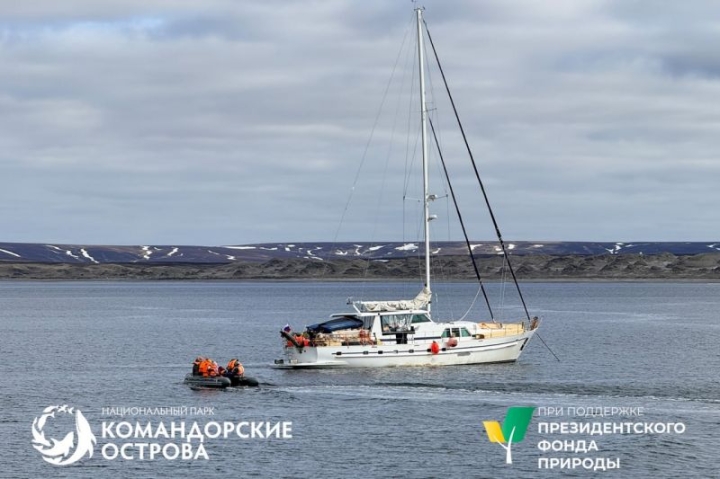
An urgent scientific expedition has commenced on Russia’s remote Medny Island, a critical part of the Commander Archipelago, as specialists from the Komandorsky National Park embark on a vital mission to assess and protect the island’s unique and highly vulnerable ecosystems. Running until mid-August, this ambitious endeavor primarily targets the critically endangered Medny Arctic fox, an endemic subspecies teetering on the brink of extinction.
The multi-faceted expedition focuses on comprehensive wildlife monitoring across the island and its surrounding waters. Researchers are meticulously tracking populations of marine mammals, various seabird species, and other species listed in Russia’s Red Book, including Steller sea lions, sea otters, northern fur seals, and humpback whales. However, the plight of the Medny Arctic fox, with fewer than 50 adult individuals remaining, stands as the expedition’s most pressing concern.
To avert the imminent loss of this unique canid, the team is undertaking a detailed census of the foxes, alongside an exhaustive survey of all known dens and shelters. A critical component of their work involves actively searching for and documenting new habitats. Furthermore, a crucial health intervention is planned, with scientists preparing to administer necessary treatments to the foxes to combat parasitic infections that further jeopardize their survival.
Beyond immediate conservation efforts, the expedition lays groundwork for future scientific endeavors. A significant objective is the construction of a new, permanent research station. This facility is envisioned to provide modern, comfortable conditions for future researchers, significantly expanding the scope and efficiency of long-term ecological studies on the island.
Operating in one of the world’s most isolated environments, the team faces considerable logistical challenges. All essential supplies, from sophisticated scientific equipment to provisions and personal necessities, have been transported to the island. Communication with the mainland will be severely limited, underscoring the self-reliance and profound dedication required by these scientists to conduct their vital work.
Medny Island serves as an irreplaceable sanctuary for a plethora of rare and vulnerable species, whose preservation is paramount to the health of the entire North Pacific ecosystem. The Medny Arctic fox holds a particularly pivotal ecological role as the island’s sole terrestrial predator and one of the most distinctive canid species globally. The data collected during this expedition will form the bedrock for developing robust, long-term conservation strategies crucial for the survival of this unique subspecies and the broader biodiversity it represents.
Covering an area of 186 square kilometers and stretching 56 kilometers in length, Medny is the second-largest island in the Commander Archipelago, discovered in 1741 by Vitus Bering’s expedition. Its historical narrative is rich but marked by human transience. In the 19th century, Aleut settlers from Alaska’s Attu Island established the village of Preobrazhenskoye, which thrived until its closure in 1968, leading to the relocation of all residents to Bering Island.
More recently, Medny hosted a border outpost, “Preobrazhenskaya,” until 2002. Its closure followed a tragic incident on August 24, 2001, when eight border guards were lost to the open ocean, underscoring the unforgiving nature of this remote environment. Today, the island stands as a testament to untamed wilderness, offering a rare glimpse into pristine natural processes and the enduring struggle for survival among its unique inhabitants.
The findings from this expedition are eagerly awaited by the international scientific community, promising to offer invaluable insights into environmental preservation and the intricate balance of fragile island ecosystems, setting a precedent for global conservation efforts.