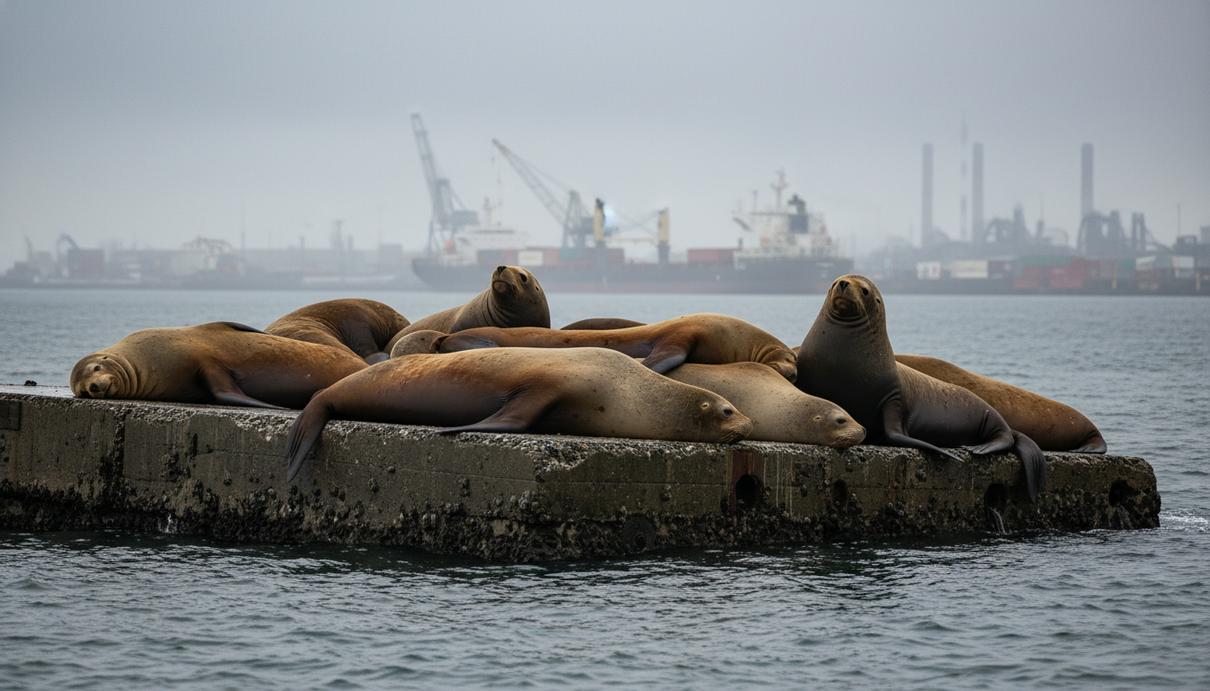
Petropavlovsk-Kamchatsky, Russia – In a concerning development underscoring mounting ecological pressures, the majestic Steller sea lions (Eumetopias jubatus) have prematurely abandoned their traditional winter haul-out sites within the urban limits of Petropavlovsk-Kamchatsky. Experts note that by April 27th of the 2025-2026 season, the waters of Avacha Bay, typically bustling with these iconic pinnipeds, were entirely deserted, two weeks ahead of their usual migration schedule. This early exodus points to a deteriorating urban environment for these protected marine mammals.
Specialists from the Kamchatka Branch of the Pacific Institute of Geography attribute this accelerated migration to natural territories to the significant degradation of wintering conditions adjacent to the city’s extensive port infrastructure. Historically, these large marine mammals have sought refuge in established rookeries within Mokhovaya Bay, at Cape Chavyca, and near active fish processing facilities. During the past winter season, a peak count of 194 individuals was recorded on December 18th, followed by a spring peak of 181 animals by late March. However, these numbers, combined with the premature departure, underscore a worrying trend of diminishing safe and suitable resting areas for the Steller sea lion population in the region.
Rapid urban and industrial development within Petropavlovsk-Kamchatsky has directly impacted the distribution and well-being of the sea lion population. A rookery that had formed in the thriving fish port area in 2022, for instance, was completely abandoned by early 2025, no longer offering a safe haven. Similarly, the crucial haul-out space in Mokhovaya Bay is experiencing a swift reduction; remnants of an old pier are progressively submerging, while a new structure erected in 2024 appears to actively deter the animals. Consequently, the primary burden of providing resting grounds has shifted disproportionately to Cape Chavyca, raising concerns about its long-term capacity and sustainability for the growing population.
Life within the city limits imposes a relentless toll on these animals, subjecting them to perpetual stress. The waters of Avacha Bay are routinely exposed to pollution, a direct consequence of ongoing port activities. Moreover, in these busy port zones, Steller sea lions frequently suffer mechanical injuries, often inflicted by entanglement in discarded fishing gear or collisions with maneuvering vessels. Adding to their plight, unregulated tourism poses a significant threat. Unscrupulous individuals, seeking close-up photographs, often approach the sea lions too closely, even from the water on paddleboards from Seroglazka Bay, forcing the animals into emergency evacuation from their resting spots, disrupting vital rest periods essential for their health and survival.
An often-overlooked yet critical threat comes from the proliferating populations of stray dogs around the port. These feral packs not only display aggressive behavior towards the marine mammals, frequently chasing them into the water, but also act as potential vectors for zoonotic diseases. Such infections could pose a severe risk to the wild fauna, including the already vulnerable Steller sea lions, raising broader public health and conservation concerns.
The premature departure of Steller sea lions from Petropavlovsk-Kamchatsky serves as a stark reminder of the escalating conflicts between urban expansion and wildlife conservation. This incident in Kamchatka, home to a significant population of these impressive pinnipeds, underscores the urgent need for integrated urban planning and robust environmental protection measures to ensure the survival of iconic species in the face of relentless human development. Without concerted efforts, critical habitats will continue to shrink, pushing vulnerable populations further towards precarious futures.