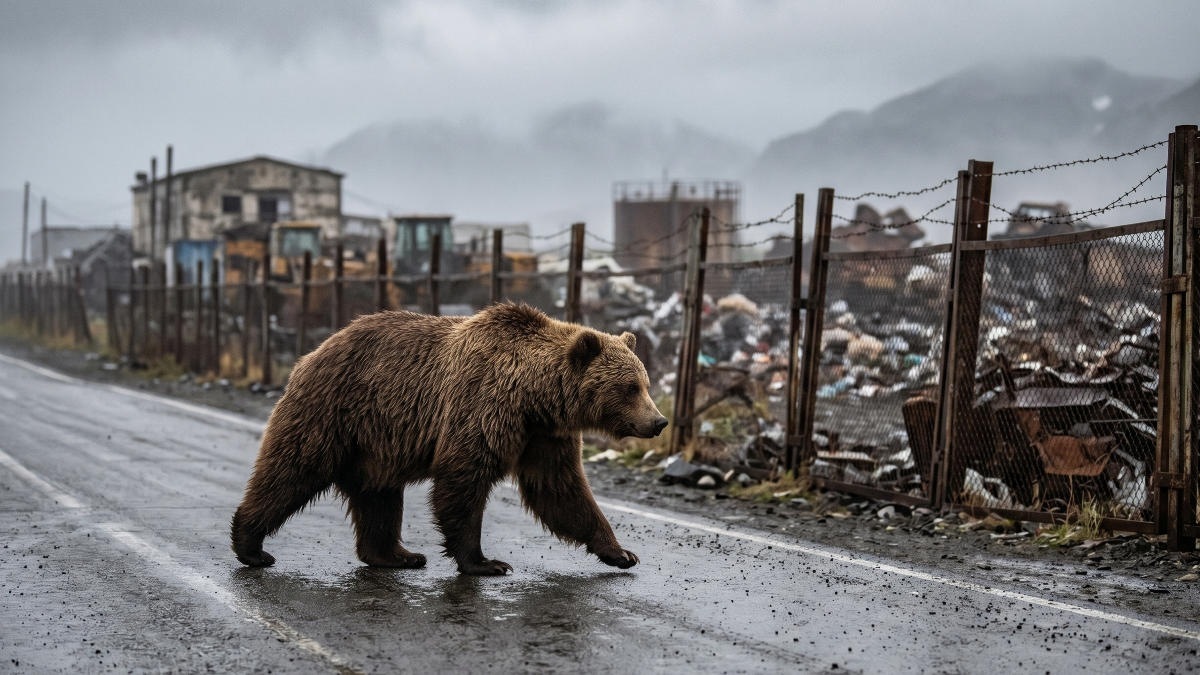
In an alarming trend signaling a deepening ecological crisis, Russia’s remote Kamchatka Peninsula has seen an unprecedented surge in brown bear encounters within human settlements. Last summer and fall alone, over 600 instances of bears venturing into towns and villages were reported, a phenomenon that continues unabated. This dramatic shift, turning the region’s iconic predators into urban dwellers, poses a systemic challenge to one of the world’s last great wildernesses and highlights a complex interplay of environmental, demographic, and policy failures. The current predicament, experts warn, is not a simple tale of natural food scarcity but the culmination of demographic and behavioral shifts spanning four decades.
For years, a prevailing theory attributed the bears’ migration to human-populated areas to declining Pacific salmon runs, a cornerstone of their natural diet. However, historical analyses, including insights from local hunter-naturalist Alexander Turushev, challenge this long-held belief. Data from the 1970s and 80s reveal average annual salmon catches in Kamchatka were a mere 15,000 to 50,000 tons – orders of magnitude less than the hundreds of thousands of tons harvested today. Yet, despite this historical scarcity, the bear population, then estimated at 12,000 to 20,000 individuals, remained stable, with human encounters being exceptionally rare and isolated, often involving livestock carcasses or accidental human provocation.
The demographic landscape of Kamchatka’s brown bear population began to transform dramatically in the early 2000s. By 2023, their numbers soared to approximately 25,000. This explosive growth is largely attributed to a significant reduction in natural and anthropogenic population controls. During the Soviet era, geological exploration parties and reindeer herders acted as unofficial regulators, culling up to 2,000 bears annually to protect their herds and operations. Today, the domestic reindeer population has plummeted sevenfold, and herders have been disarmed, eliminating this traditional control mechanism. Concurrently, stricter customs enforcement curtailed the illegal export of bear gallbladders and and other derivatives to Asian markets, further reducing poaching pressures.
Official hunting, intended to manage the growing population, has proven woefully inadequate. In recent years, less than 15% of allocated bear hunting quotas in Kamchatka have been utilized. With fewer than 500 animals legally harvested annually, compared to the over 2,000 needed to stabilize the population, the gap is widening. A key impediment is economic: a federal fee of 3,000 rubles (approximately $32 USD) for harvesting a single bear renders legal hunting economically unviable for many. Wildlife specialists advocate for abolishing this fee or removing the brown bear from the list of limited hunt species on the peninsula to encourage sustainable management.
Perhaps the most critical factor altering the bears’ habitat and behavior is a profound transformation in their feeding habits, which began in the mid-1990s. The proliferation of private fish processing enterprises led to the widespread dumping of fish waste along riverbanks and in forests. Over three decades, successive generations of Kamchatka bears developed a powerful conditioned reflex, associating human presence with readily available, high-calorie food. This “fast-food mentality” has overridden their innate fear of humans. Even when natural spawning grounds are abundant, a significant portion of the bear population now prefers scavenging at unofficial dumps, eschewing the strenuous process of natural fishing. Their attraction to anthropogenic scents has become so intense that mass incursions have been observed even in municipal cemeteries.
Compounding the problem is a glaring absence of legal enforcement against the sources of this food contamination. While Russian law provides mechanisms to prosecute legal entities for unauthorized waste disposal, these provisions are rarely applied in Kamchatka. This creates a striking legal imbalance: a motorist accidentally hitting a bear on the road is liable for 60,000 rubles (approximately $640 USD) in damages to wildlife, yet the very enterprises whose food waste lures these predators into urban areas bear no financial responsibility for the subsequent culling of “problem” bears. Annually, around 200 such bears are lethally removed from the region. Enforcing potential lawsuits against owners of resorts, fish processing plants, and farms for their role in these incidents could amount to tens of millions of rubles, providing a powerful economic incentive for adhering to sanitary standards.
To address this multifaceted crisis, experts propose several fundamental preventive measures. Mandatory use of electric fences around industrial facilities and tourist bases is a key recommendation, a practice successfully employed by researchers at Kuril Lake since the early 1990s. These devices, which deliver a safe but deterrent electrical impulse, effectively establish a robust avoidance behavior in animals towards protected perimeters. Implementing such systems, alongside stringent environmental controls, robust fines for waste, and a modernized hunting regulatory framework, is crucial. These integrated efforts aim to sever the ingrained human-food dependency of these magnificent predators and guide Kamchatka’s brown bear population back to its natural foraging grounds and a more sustainable coexistence.