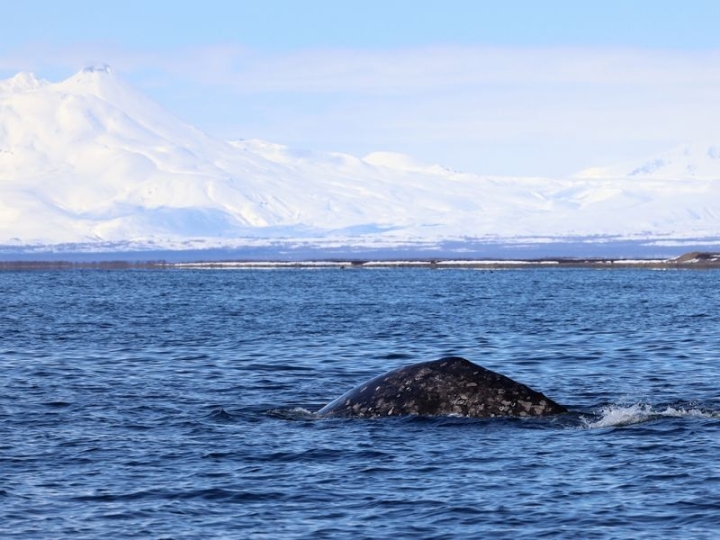
Gray whales have successfully completed their monumental 8,000-kilometer migration from the warmer breeding grounds off California’s Baja Peninsula, arriving back in the rich feeding waters of Kronotsky Bay on Russia’s Kamchatka Peninsula. This annual trans-Pacific odyssey, a testament to nature’s enduring cycles, signals the start of the feeding season for these magnificent marine mammals in the North Pacific. According to officials at the Kronotsky State Reserve, who shared their observations with the KAMCHATKA-INFORM news agency, the first sightings of these long-distance travelers occurred earlier than usual this year, marking a significant ecological event for marine biologists monitoring their populations.
Researchers from the reserve initially spotted a lone gray whale from the shoreline on April 19, a harbinger of the migration wave. While subsequent sightings became a daily occurrence, adverse weather conditions prevented researchers from launching their marine surveys by boat until late April. Despite these initial delays, the team managed to conduct three extensive surveys along a designated route stretching from Olga Bay to the Kronotsky Liman, setting a new record for the earliest start to their annual field season, which typically commences in early May.
During their initial expeditions, researchers documented a total of nine individual gray whales. The first boat trip yielded sightings of three whales, followed by five on the second outing, and two more on the third. Observations indicate that the whales are currently lean, a perfectly natural condition at the beginning of their feeding phase after the arduous journey and limited feeding opportunities during migration and breeding. Scientists anticipate a much larger influx of these colossal creatures into the bay throughout May as the migration peaks.
This annual return of the gray whales to Kamchatka is a critical event, not only for the whales themselves, which rely on these nutrient-rich waters for sustenance, but also for international conservation efforts. Their precise migratory patterns and population health are closely monitored by scientists across the Pacific Rim, offering valuable insights into marine ecosystem health and the impacts of environmental changes on global wildlife.