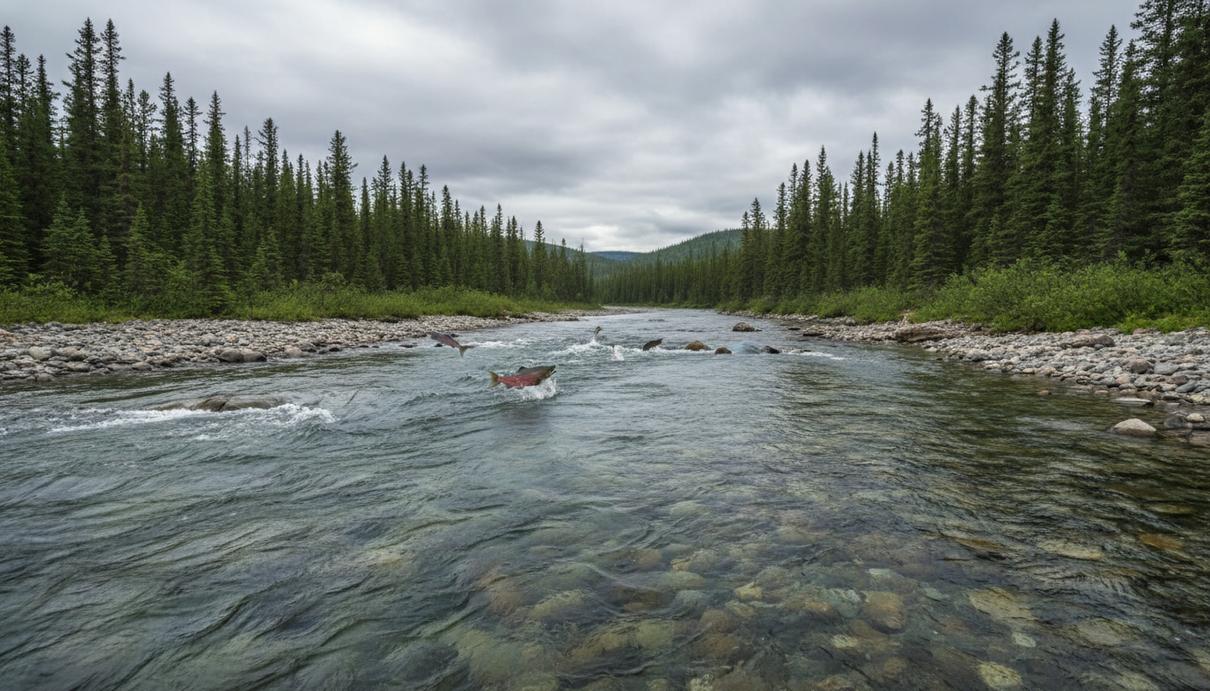
The Far Eastern Scientific and Fishing Council, convening in Vladivostok, has released its final salmon catch forecast for the current year, projecting a total haul of 227,000 metric tons across Russia’s Far East. This figure, a critical indicator for global seafood markets, reveals a concerning trend despite Russia’s pivotal role as a major Pacific salmon producer. While over half of this anticipated catch, approximately 117,400 metric tons, is allocated to the Kamchatka Peninsula—Russia’s most significant salmon fishing region—the outlook is shadowed by historical declines. Local experts consider this Kamchatka-specific forecast relatively optimistic, yet it falls significantly below previous years; even in historically ‘poor’ seasons like 2022 and 2024, catches regularly exceeded 130,000 metric tons, signaling a worrying downturn in vital Pacific salmon populations that impacts international supply.
The projected volumes for Kamchatka are nearly evenly distributed between its eastern and western coasts, though with distinct variations in species composition, which could influence processing and export dynamics. The eastern coastline anticipates a yield of approximately 59,500 metric tons of salmon, primarily pink salmon (nearly 39,600 tons), alongside chum and sockeye. In contrast, the western coast’s quota is set at 57,900 metric tons, where sockeye salmon is expected to dominate with an estimated harvest of 27,000 tons, while pink salmon catches are limited to a more modest 10,000 tons. These regional differences highlight the complex management of diverse salmon species and their varying health.
The industrial fishing season is slated to begin on June 1st in the Ust-Kamchatsky District, specifically within the Kamchatka River basin, with other regions gradually joining the effort until the season concludes by September 30th. Recreational fishing will also commence on June 1st across most of the peninsula’s waterways, but with a crucial environmental safeguard: a complete prohibition on net fishing gear. Further specific regulations apply to the Paratunka and Avacha rivers, where amateur angling will be permitted only from July 5th, demonstrating a phased approach to resource preservation.
In response to declining stocks and the imperative of conserving salmon populations, regulatory bodies are implementing a series of stringent new restrictions that underscore the gravity of the situation. A comprehensive ban on both industrial and recreational fishing is now in effect across the entire Avacha Bay. Furthermore, the highly sought-after Chinook and sockeye salmon are entirely off-limits for all user categories in the Avacha and Paratunka rivers. Industrial fishing activities in the Kamchatka River basin, within the Milkovsky District, face a substantial multi-year suspension until the end of August 2026. Similar restrictive measures extend to the western coast, where the harvest of Chinook salmon is now forbidden in the West Kamchatka and Kamchatka-Kuril subzones, and several critical river basins—Opal, Golygina, Koshegochek, Pervaya Yavinskaya, and Vtoraya Yavinskaya—are entirely closed to both net fishing and industrial operations. These sweeping prohibitions reflect urgent efforts to manage dwindling fisheries resources, with potential ripple effects on global seafood trade and international conservation dialogues concerning shared marine ecosystems.