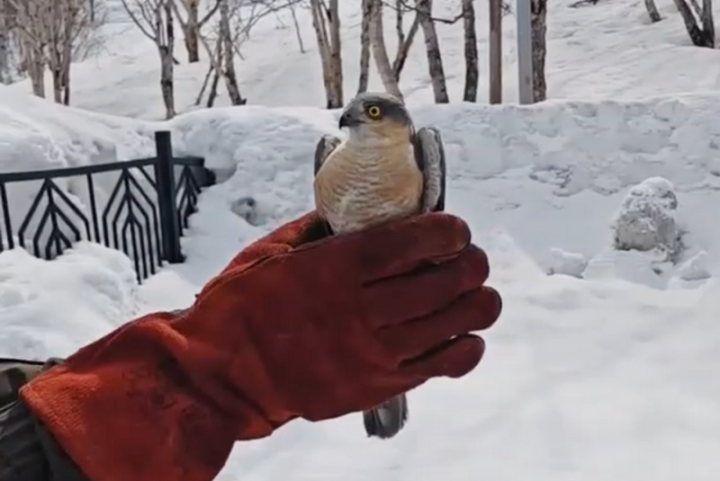
In a striking incident that underscores the increasingly intertwined relationship between urban development and wildlife, a predatory bird unexpectedly entered a residential building in Petropavlovsk-Kamchatsky, a major city on Russia’s Far Eastern Kamchatka Peninsula. The unusual event unfolded around noon on April 14, reportedly driven by the hawk’s intense pursuit of prey, which led it into the entrance of an apartment block on Leninskaya Street in the city center. This peculiar occurrence has drawn attention to the dynamic interactions between nature and human habitation in the region.
Residents, taken aback by the sudden appearance of the feathered intruder, quickly took action. Demonstrating a remarkable display of civic responsibility and concern for wildlife, they carefully managed to secure the bird in a container before contacting the local Wildlife Protection Service for assistance. Their swift and gentle intervention was crucial in ensuring the animal’s safety after its unexpected urban detour, preventing potential harm to both the bird and the building’s occupants.
A game warden from the service promptly arrived at the scene to assess the situation. After a thorough examination, the specialist identified the raptor as a Eurasian Sparrowhawk, a common but formidable bird of prey known for its agility. Fortunately, the hawk appeared to be unharmed, showing no signs of injury from its tumultuous entry. Following a brief observation, the uninjured bird was safely released back into its natural habitat, soaring once again into the vast Kamchatkan skies.
This incident, while captivating, is not an isolated occurrence within the region, highlighting a recurring pattern of human-wildlife interface challenges. Just months prior, on January 27, another sparrowhawk found itself in a similar predicament, entering a building through a broken window in the Rabykovskaya district. Disoriented and distressed in the unfamiliar confines, the bird repeatedly collided with glass surfaces in its desperate attempts to escape. It was eventually rescued by the same dedicated wildlife protection agency, underscoring the continuous efforts required to manage such encounters.
These repeated events in Petropavlovsk-Kamchatsky serve as vivid reminders of the challenges and opportunities presented by expanding urban environments meeting natural ecosystems. They emphasize the delicate balance between human habitation and the preservation of diverse wildlife, often bringing the wild world unexpectedly close to our doorsteps, and underscoring the vital role of dedicated wildlife services and informed public action in ensuring their safe coexistence globally.