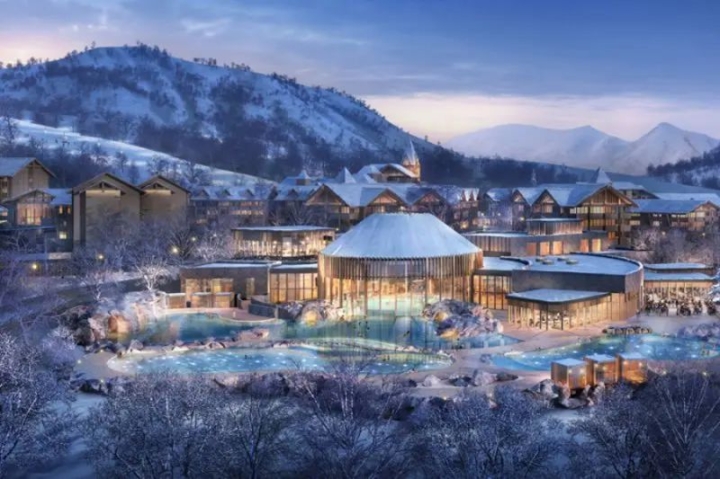
A significant environmental review is underway for the ambitious “Three Volcanoes Park” project in Russia’s ecologically sensitive Kamchatka Peninsula, signalling a concerted effort by key stakeholders to ensure sustainable development. The “Kompas” Foundation, a non-profit dedicated to environmental initiatives, has formally partnered with “Interros,” one of Russia’s largest investment companies, and the “Three Volcanoes Park” developer to provide comprehensive ecological oversight for the multi-million dollar tourism venture.
This collaboration will see a broad coalition of experts, including representatives from state environmental agencies, leading scientific institutions, research centers, national parks, and ecological organizations, conducting an in-depth analysis of the “Three Volcanoes Park” concept. Their mandate is to evaluate the project’s long-term environmental sustainability within the pristine region, develop a detailed catalogue of necessary conservation measures, and formulate strategies to minimize any potential ecological impact.
Kamchatka is globally renowned for its unparalleled natural beauty and critical biodiversity, home to an intricate web of vital salmon spawning rivers, crucial animal migration routes, and unique ecosystems found nowhere else on Earth. The “Three Volcanoes Park,” planned as an international-class tourist cluster near the iconic Vilyuchinsky, Mutnovsky, and Gorely volcanoes, is inherently situated within this highly sensitive environment, demanding meticulous planning and execution.
Igor Dunaev, CEO of “Three Volcanoes Park,” underscored the project’s commitment to ecological stewardship. “Our partnership with the Kompas Foundation allows us to embed environmental expertise into every phase of design, from infrastructure layout to ecosystem load assessment and monitoring systems,” Dunaev stated. “For us, it is fundamentally important that development does not disrupt Kamchatka’s natural balance. Instead, our experience should serve as a benchmark for responsible development in unique natural territories.” This sentiment aligns with Interros’s broader corporate philosophy, which has previously applied similar environmental safeguards to projects such as the Rosa Khutor resort within the Sochi National Park.
Tatiana Kovaleva, Director of the “Kompas” Foundation, emphasized the universal relevance of environmental responsibility. “Ecological accountability is the bedrock for any business aspiring to a sustainable future, particularly in regions with such unique natural heritage as the Kamchatka Krai,” Kovaleva noted. “It is imperative that responsible environmental practices evolve from an exception to an integral component of all major development projects.” The “Kompas” Foundation, established in 2022, champions educational, public, and expert-driven environmental projects, fosters regional ecological initiatives, and promotes dialogue on conservation and sustainable development.
“Interros,” founded by Vladimir Potanin in 1990, boasts a diverse investment portfolio spanning metallurgy, mining, real estate, and tourism, including prominent assets like Norilsk Nickel and the Rosa Khutor resort. The company positions its “Three Volcanoes Park” resort, located approximately 80 kilometers from Petropavlovsk-Kamchatsky, as a flagship international tourism destination. The move to initiate a comprehensive eco-audit follows previous assurances from Kamchatka Governor Vladimir Solodov, who dispelled rumors of the project’s cancellation or major reformatting, highlighting the ongoing commitment to its realization under strict environmental guidelines.
This detailed review underscores a growing trend towards integrating environmental considerations into large-scale development, particularly in globally significant natural areas, reflecting an evolving standard for corporate responsibility and sustainable practices.