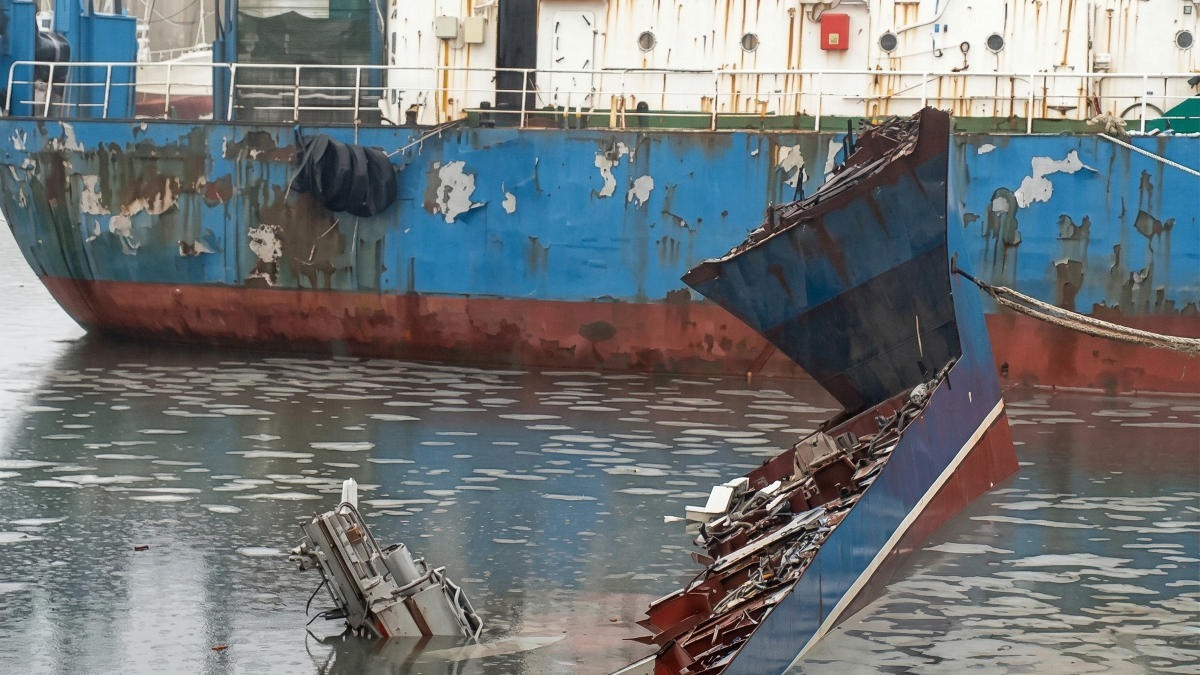
A Russian arbitration court has delivered a significant verdict, ordering the company Neftegazservis to pay 180.5 million rubles (approximately $2 million USD) in damages for severe environmental pollution in Avacha Bay, a crucial waterway off Russia’s Far Eastern Kamchatka Peninsula. The ruling follows an incident last spring that saw a decommissioned border patrol ship, the “Vorovsky,” sink during dismantling, unleashing a cascade of pollutants into the pristine waters.
The environmental catastrophe unfolded on April 18, 2023, in Zovodskaya Bay. Neftegazservis, contracted to scrap the vessel for metal, was carrying out the operation directly at the pier when the ship unexpectedly lost buoyancy and submerged. This catastrophic failure resulted in the immediate release of petroleum products and various technical fluids into the marine ecosystem, prompting immediate concern from environmental agencies.
Russia’s Federal Service for Supervision of Natural Resources (Rosprirodnadzor) swiftly assessed the ecological damage, quantifying it at the substantial sum of 180.5 million rubles. The agency initially presented this claim to Neftegazservis for pre-trial compensation. However, the company reportedly ignored these demands, compelling Rosprirodnadzor to escalate the matter to the arbitration court in Russia’s Chelyabinsk Region, which ultimately sided with the environmental watchdog, mandating full restitution for the harm inflicted upon the aquatic environment.
The sunken vessel, the “Vorovsky,” boasts a long and storied history, having served for over three decades as a border patrol ship. Commissioned in the autumn of 1991, it diligently patrolled the waters off Kamchatka, a region of immense strategic and ecological importance. Despite facing funding shortages in the 1990s that led to temporary decommissioning, the “Vorovsky” returned to active service in the early 2000s. Its crew played a critical role in safeguarding marine biological resources and actively combating poaching operations, often intercepting dozens of violating vessels, including those operating under foreign flags, and at times resorting to the use of official weaponry to enforce maritime law.
After a distinguished career, the border guard service officially retired the aging patrol ship in 2020. Two years later, the decommissioned asset was sold to a commercial entity for scrap. What was intended as a routine decommissioning process, however, tragically culminated in a significant pollution event, with the arbitration court now definitively assigning environmental responsibility to the contractor, Neftegazservis, underscoring Russia’s commitment to holding entities accountable for environmental degradation, even in the complex realm of military asset disposal.