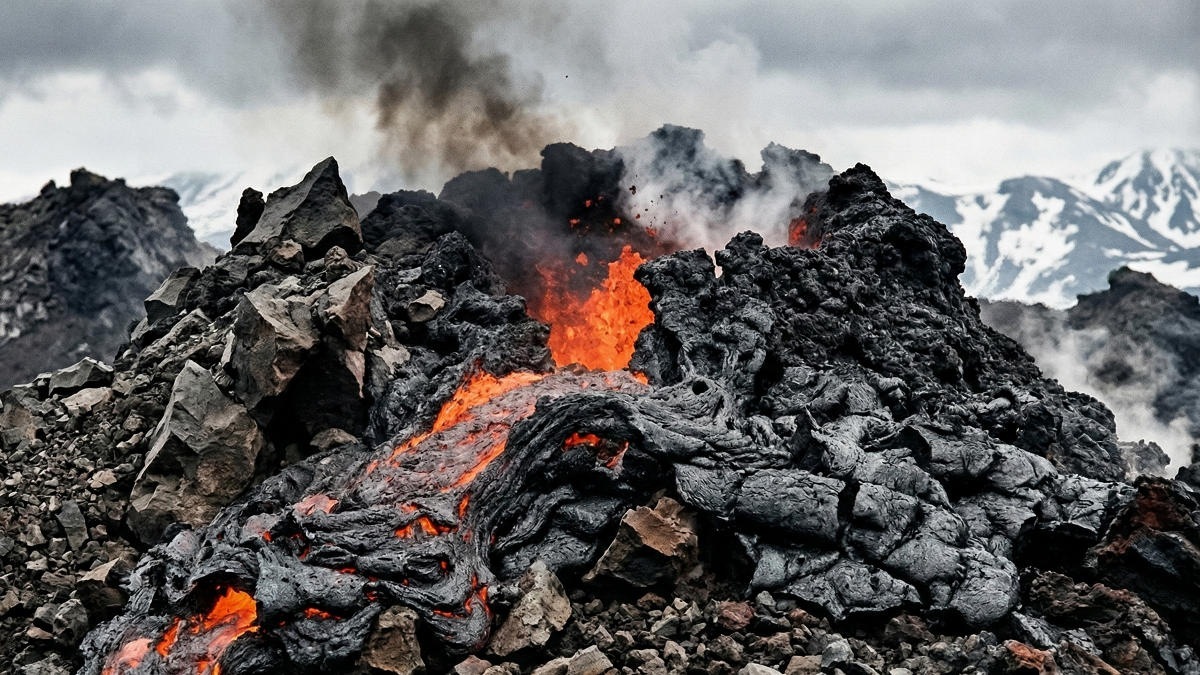
Kamchatka’s Shiveluch volcano, a prominent fixture of Russia’s remote Far East, is currently undergoing a significant geological transformation. Scientists are closely monitoring the continuous formation of a new volcanic dome, which has now reached an impressive height of 2.4 kilometers above sea level. This development, while currently proceeding without the explosive ash emissions that previously characterized the volcano, is a stark reminder of the dynamic forces at play in one of the world’s most volcanically active regions.
Experts from the Institute of Volcanology and Seismology of the Far Eastern Branch of the Russian Academy of Sciences report that the current geological process is unfolding smoothly, without “sharp jumps” or powerful ash plumes. However, a mesmerizing glow has been observed in the vicinity of the crater during nighttime hours, indicating persistent magmatic activity beneath the surface. This nocturnal luminescence serves as a visible sign of the latent power contained within the colossal peak.
The genesis of this new center of volcanic activity can be traced back to late December 2025, when it first emerged on the northwestern slope of what is known as Molodoy Shiveluch, or Young Shiveluch. The initial stages of its growth were far more dramatic; throughout January and February 2026, the expanding formation was accompanied by formidable ash emissions that soared up to nine kilometers into the atmosphere, posing potential hazards to aviation. The new geological structure has since grown substantially, now surpassing the original dome of Molodoy Shiveluch itself, testament to its rapid and continuous development.
Shiveluch stands as one of the most active and formidable volcanoes on the Kamchatka Peninsula, with a geological history spanning an estimated 60 to 70 thousand years. Its massive complex comprises the older remnants of Stary Shiveluch (Old Shiveluch), an ancient caldera, and the more recently formed Molodoy Shiveluch. While relatively remote, its activity holds regional importance. The nearest inhabited locality, the village of Klyuchi in the Ust-Kamchatka District, lies approximately 50 kilometers from its base, ensuring constant vigilance from local authorities and residents. The larger administrative center, Petropavlovsk-Kamchatsky, is situated further afield, about 450 kilometers away, though its air corridor can still be affected by significant ash plumes.
The ongoing formation of Shiveluch’s new dome underscores the continuous evolution of Earth’s crust and the powerful geological processes that shape our planet. For volcanologists, it represents an invaluable opportunity to study dome growth dynamics in real-time, providing critical data for understanding eruption mechanisms. For the international community, Shiveluch’s persistent activity is a reminder of the global interconnectedness of natural phenomena, from potential aviation disruptions to the broader scientific pursuit of knowledge about our dynamic world.