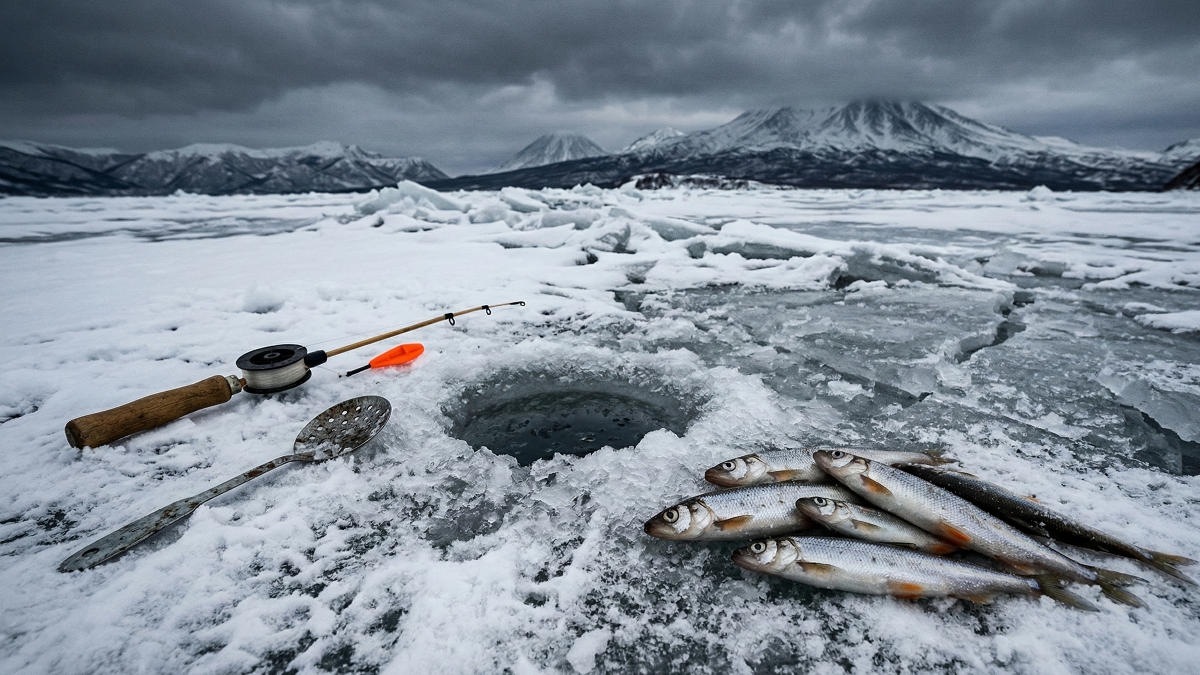
Kamchatka, Russia’s remote and ecologically vital peninsula in the Far East, is currently at the heart of a curious debate surrounding its valuable Asian toothed smelt fisheries. While local fishermen on the eastern coast have reported a significant and ongoing decline in catches, painting a bleak picture for the 2025 winter season, scientific assessments offer a surprising counter-narrative. This divergence between anecdotal evidence and expert analysis underscores the complex challenges of fisheries management in one of the world’s most pristine natural environments.
The winter fishing season at Lake Nerpichye, a significant water body in Kamchatka, proved particularly lean. Amateur anglers, a common sight on the ice, found themselves struggling, with reports of only sporadic catches. For weeks, from late January to mid-February, despite up to 70 hobbyists daily, individual take-homes averaged a mere 20-25 fish. The entire lake’s daily yield rarely exceeded 105 kilograms, often falling as low as 39 kilograms, with the average smelt weighing a modest 60 grams – a stark contrast to previous years and reinforcing the perception of a long-term downward trend in catch volumes across the peninsula’s eastern reaches.
To bridge this gap between local observations and broader ecological understanding, specialists from the Kamchatka branch of the Russian Research Institute of Fisheries and Oceanography (VNIRO) launched a targeted field expedition. Their mission was to conduct on-site research directly on the frozen lake, meticulously documenting the population’s real-time status. This rigorous scientific effort involved ichthyologists working alongside local fishermen, implementing control catches to gather comprehensive biological statistics.
Lake Nerpichye plays a critical role in the life cycle of the Asian toothed smelt. It serves as a vital habitat where the fish feed, grow, and ultimately spawn. Smelt begin migrating into the lake from mid-December, continuing through the winter and early spring, with the peak spawning season occurring in April and May. This winter-spring period has traditionally been the prime time for mass ice fishing, making the recent low yields particularly concerning for the local community and highlighting the importance of understanding any shifts in this delicate ecosystem.
During their expedition, VNIRO researchers meticulously examined each caught fish. Measurements were taken, weights recorded, and sex, maturity stage, and age were determined. While the field phase is now complete, all collected samples and data have been transferred to the ‘KamchatNIRO’ salmon laboratory for in-depth analysis. These comprehensive findings will be instrumental in formulating scientific recommendations aimed at ensuring the sustainable regulation of the smelt fishery in the region.
Despite the widespread complaints from fishermen and the modest catch statistics of the recent winter season, the scientific experts have conveyed a reassuring message regarding the overall health of the smelt population. After a thorough comparative analysis of the size-age and sex composition of fish over the past decade, biologists concluded that the Asian toothed smelt stock on Kamchatka’s eastern coast remains in a satisfactory condition. Crucially, their research found no anomalies in the age structure of the Lake Nerpichye population, with three- and four-year-old fish consistently forming the robust core of the stock, suggesting resilience rather than decline.