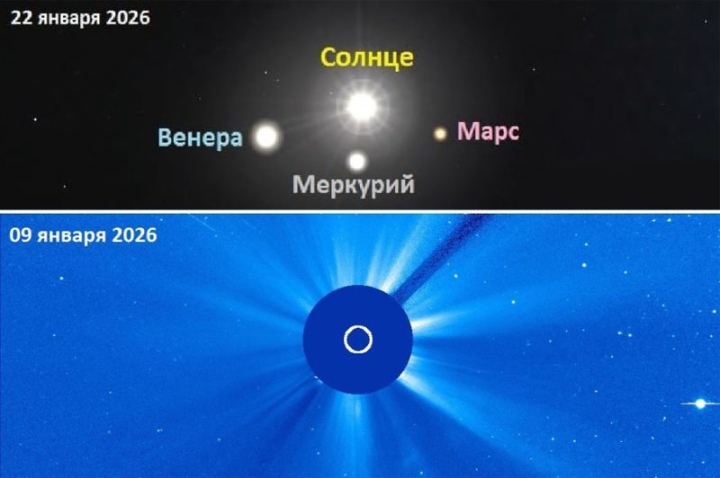
A rare celestial event is set to captivate skygazers as Mercury, Venus, and Mars prepare to align with the Sun in a unique configuration by January 22. This extraordinary “planetary parade,” described by experts, promises a spectacle that will not be seen again in such a precise form for decades, offering a moment of shared wonder across the globe. The announcement comes from the KVERT group of the Institute of Volcanology and Seismology, as reported by RAI KAMCHATKA-INFORM.
While all three planets will coalesce into their final configuration next week, their journey has been unfolding for some time. Venus and Mars recently observed a rare conjunction around Christmas, a convergence not expected for another two centuries, and are now gradually moving apart. Mercury, the fastest planet, has just emerged into view on space-borne imagery, appearing as a bright point of light approaching the solar disk. Currently, Venus and Mars remain hidden from direct photographic observation, obscured by the artificial moon of a coronagraph designed to block the Sun’s intense glare. However, astronomers anticipate they will soon drift far enough from the solar limb to become visible in subsequent images within the coming days.
The culmination of this celestial dance is expected on January 22, when the three planets and the Sun will arrange themselves into a remarkably symmetrical formation. This precise alignment will create what has been described as an almost perfect “cosmic rhombus” or even a cross in the sky, spanning an angular distance of just two to three degrees. Such a tight, symmetrical configuration is considered exceptionally rare, making this particular event a highlight for astronomical observation for at least the current century.
Following its peak on January 22, this spectacular planetary ballet will begin to unravel. Mercury, due to its rapid orbital speed, will be the first to depart from the Sun’s vicinity before the end of January. Venus and Mars will follow suit throughout February, gradually spreading out across the sky. While planetary convergences occur periodically, the next instance where all three planets will again gather near the Sun, albeit at a much wider angular separation of about 10 degrees, is not projected until September 2038. This makes the upcoming, incredibly compact three-degree alignment, coupled with its distinct symmetrical pattern, an undeniably unique and historically significant event in space observation.