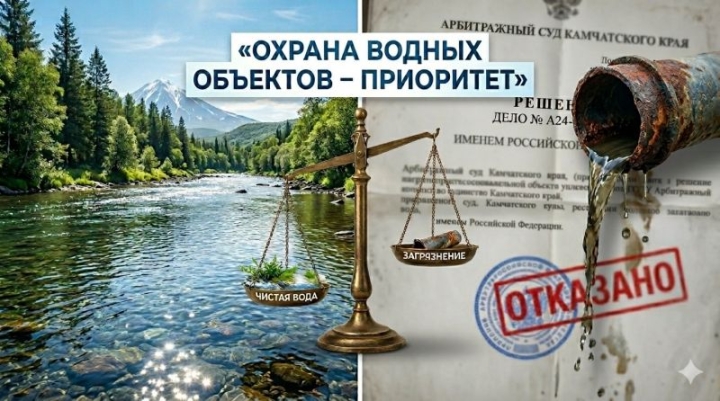
The Arbitration Court of Kamchatka Krai has issued a significant environmental ruling, rejecting a lawsuit from KamInzhiniring JSC that sought permission to discharge wastewater from the Razdolnoye rural settlement into the vital Avacha River. This decision reinforces the imperative of upholding stringent environmental safeguards in a region globally renowned for its unique natural landscapes and pristine ecosystems.
The court’s ruling favored the regional Ministry of Natural Resources and Ecology, which had previously denied KamInzhiniring’s request for wastewater disposal rights. The judicial body cited a multitude of critical reasons for its judgment, underscoring a robust commitment to preserving natural resources against potential industrial pollution – a principle increasingly at the forefront of international environmental policy and governance.
Central to the court’s refusal was the Avacha River’s designation as a crucial sanitary protection zone for the “Avachinsky” water intake, which supplies potable water to local communities. Further complicating the company’s appeal, existing wastewater treatment facilities in the Razdolnoye rural settlement were found to be entirely dilapidated, operating at 100% wear. Crucially, KamInzhiniring JSC lacked any proprietary treatment infrastructure to ensure proper purification of effluent before discharge.
Legal proceedings also highlighted significant deficiencies in the documentation submitted by the company, including inaccuracies in coordinate data and projected discharge volumes. More broadly, the court invoked the Water Code, which strictly prohibits the release of untreated wastewater into water bodies. It clarified that even treated discharge is permissible only when adequate equipment for water body protection is demonstrably in place – a condition clearly unmet in this instance. Furthermore, the regional investment program, which extends until 2030, currently makes no provisions for the construction of new treatment facilities in the affected area, pointing to a broader infrastructure challenge.
While the court’s decision is not yet legally in force, this landmark ruling sends an unequivocal message regarding the paramount importance of environmental regulations and infrastructure investment in protecting sensitive ecological zones. It serves as a powerful reminder of the ongoing global challenges faced by regions striving to balance economic development with the preservation of invaluable natural heritage, especially in areas of significant biodiversity like Kamchatka.