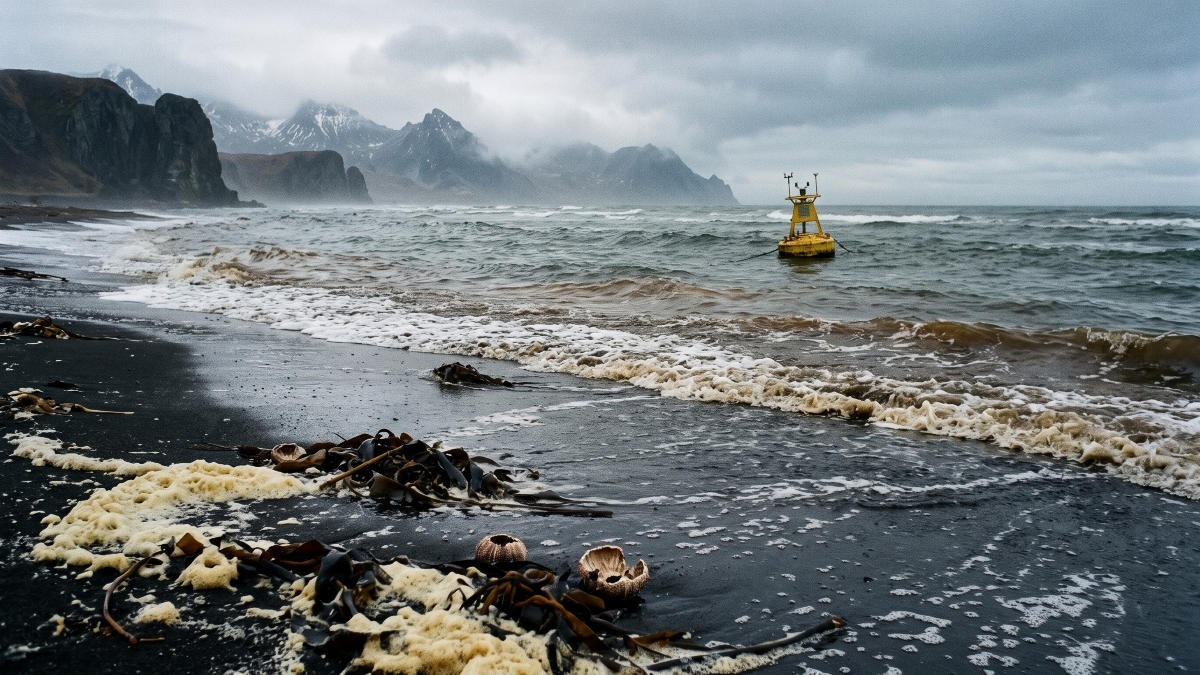
Russian oceanographers and marine biologists are developing an early warning system off the coast of Kamchatka to detect harmful blooms of Karenia microalgae. In the autumn of 2020, a mass proliferation of this phytoplankton caused widespread mortality among benthic marine life and adverse health effects among coastal residents. While current concentrations of the hazardous cells in coastal waters remain hundreds of times below critical thresholds, specialists are working to identify emerging threats several weeks before conditions escalate.
During recent October surveys, researchers at the regional fisheries and oceanography institute KamchatNIRO recorded only a few thousand Karenia cells per liter in water samples. By comparison, at the peak of the autumn 2020 crisis, cell densities reached 100,000–620,000 per liter, with the microalgae accounting for nearly the entire phytoplankton biomass in some areas. Kirill Vinnikov, director of the Institute of the World Ocean at Far Eastern Federal University, explained that Karenia microalgae are natural inhabitants of Far Eastern seas and their presence alone does not signify an ecological disaster. The time lag between the appearance of several thousand cells and a full-scale bloom can span several weeks – providing a window to alert fishing fleets, step up seafood inspections, and prepare emergency services.
In autumn 2020, the marine event was recognized only after complaints from surfers at Khalaktyrsky Beach and mass strandings of dead marine animals. At that time, Karenia selliformis was the dominant species along the coast, accompanied in smaller numbers by the related species K. mikimotoi and K. papilionacea. Coastal waters turned brown, and the bloom persisted for roughly two months across tens of thousands of square kilometers. On surveyed sections of the seabed at depths between 5 and 20 meters, nearly all sea urchins, mollusks, and octopuses perished.
The mechanism behind the marine fauna die-off involves the release of biologically active compounds. Certain Karenia strains produce substances that damage the gills and outer tissues of marine animals, leaving slow-moving bottom dwellers and filter feeders most vulnerable. While K. selliformis is typically associated with gymnodimine phytotoxins, the exact toxicity of the local cold-water variant remains under study; genetically identical Japanese strains identified off Hokkaido in 2021 contained no gymnodimines. No confirmed cases of severe human poisoning from these toxins have been documented in scientific literature, though a potential risk persists through mollusks that accumulate toxins while filtering water. Direct contact with affected water also poses a hazard – in 2020, dozens of surfers sought medical attention for eye irritation, sore throats, and nausea, underscoring that entering the sea and consuming local seafood during phytoplankton outbreaks must be avoided until cleared by health authorities.
Distinguishing routine seasonal fluctuations in algal populations from the onset of an ecological crisis requires multi-year observation datasets. In Avacha Bay, KamchatNIRO has conducted regular sampling at permanent monitoring stations since 2013. Laboratory microscopy remains the foundational method: water samples are fixed, concentrated, and examined for cell counts. While this procedure yields rapid and accurate results, it reflects conditions only at a single sampling point. Moreover, light microscopy cannot always differentiate between closely related Karenia species, and isolated cells are easily overlooked at very low concentrations.
Satellite remote sensing helps researchers evaluate conditions across the broader marine area. By analyzing the spectrum of light reflected off the sea surface, satellites measure chlorophyll concentrations, turbidity, and water discoloration. In 2020, satellite imagery revealed the full extent of the bloom – a patch measuring more than 300 by 100 kilometers. Although satellites cannot detect a bloom at low cell densities, algorithms calibrated against physical water samples allow researchers to track rising concentrations, shifts in dominant species, and direct survey vessels to marine quadrants requiring urgent sampling.
Under the 2024–2026 Interdepartmental Comprehensive Program for Scientific Research of the Kamchatka Peninsula and Adjacent Waters, scientists are supplementing conventional sampling with automated systems. The monitoring network is incorporating moored buoy stations outfitted with underwater spectrophotometers and fluorometers that transmit continuous data, alongside flow-through imaging microscopes. These instruments photograph microorganisms directly within the water column, while neural networks classify potentially hazardous species. Nevertheless, the region’s severe climate limits the reliability of automated equipment: heavy storms, biological fouling of sensors, seasonal ice cover in certain bays, and the remoteness of the extensive coastline mean manual water sampling cannot be fully replaced.
Optical instruments alone are insufficient for definitive species identification and toxin screening. In laboratories, specialists deploy electron microscopy and molecular genetic techniques, including environmental DNA metabarcoding, which maps the entire species composition of a sample down to rare organisms. The presence of toxins is verified separately using enzyme-linked immunosorbent assays and mass spectrometry. Because a full analytical cycle takes from several days to several weeks, operational decisions rely on faster cell-count data, while molecular biology provides precise scientific verification.
Halting a bloom once it is underway in the open ocean is technically impossible. Internationally, in small enclosed areas – such as near aquaculture farms – algae are occasionally precipitated to the seabed using specialized clays, a technique that carries side effects for benthic ecosystems and cannot be scaled across thousands of square kilometers. Outbreaks typically subside due to natural factors, including autumn cooling, storm-driven water mixing, and diminishing daylight. However, in 2020, the microalgae proliferated actively in cold water at temperatures of 7–13 degrees Celsius, demonstrating that natural seasonal barriers are not always reliable.
Timely public advisories and targeted restrictions remain the only effective protective measures. Warning indicators for scientists include a steady rise in cell counts across consecutive samples, simultaneous detection across multiple bays, water discoloration, foam formation, and marine animal mortality. When these signs emerge, researchers expand their network of monitoring stations, cross-reference water samples with satellite data, and transmit findings to the federal health watchdog Rospotrebnadzor, the Ministry of Emergency Situations, and regional authorities. Those agencies hold the mandate to prohibit swimming and suspend seafood harvesting, while the scientific community focuses on supplying verified data and communicating updates calmly to residents.