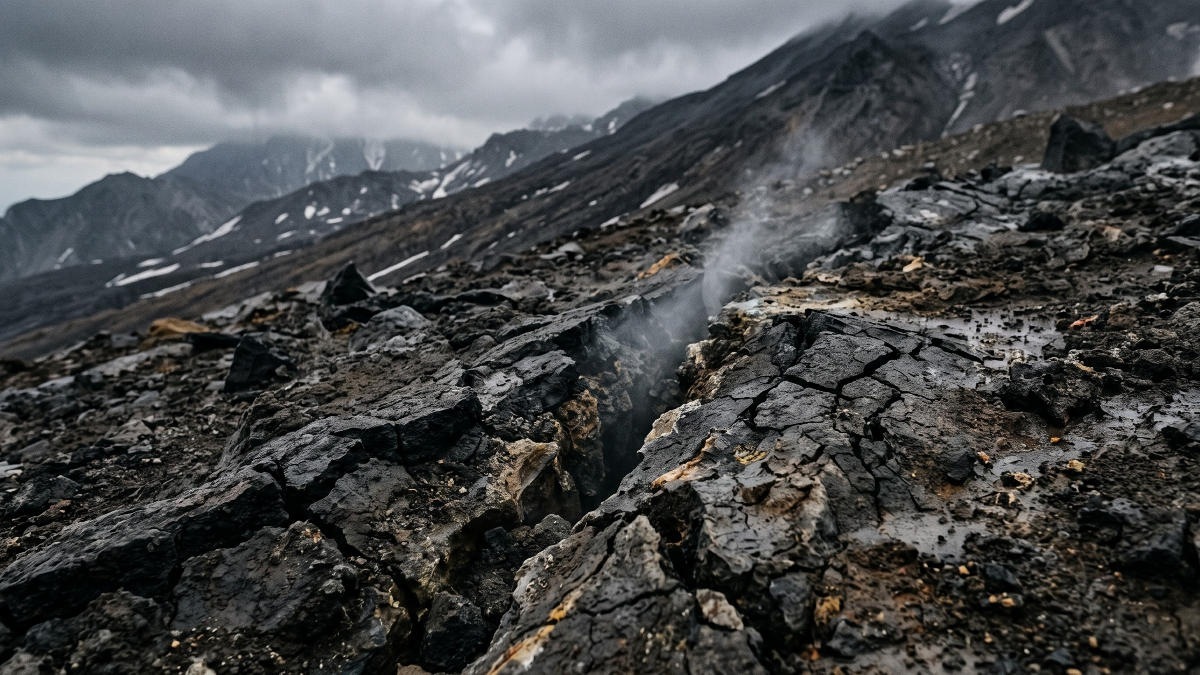
In August 2025, an 8.8 magnitude earthquake triggered the eruption of the Krasheninnikov volcano on the Kamchatka Peninsula, altering the understanding of how seismic and volcanic activities interact. The volcano had previously been in a state of deep dormancy. For nine years, satellite observations recorded no signs of an awakening. Radar data indicated only a slow subsidence of the ground, and atmospheric monitoring instruments detected no sulfur dioxide emissions. The magmatic system appeared entirely stable until July 29, when a massive earthquake occurred in the Pacific Ocean, 230 kilometers south of the caldera.
Almost immediately after the tremor, satellites detected a rapid change in surface deformation around the volcano. The displacement pattern indicated that magma had begun to ascend rapidly from a reservoir located at a depth of approximately six kilometers, forming a vertical fissure filled with melt – known as a dike. By August 2, initial ash emissions reached altitudes of up to ten kilometers, and a fissure opened on the northwestern slope, releasing lava. Massive volumes of volcanic gases entered the atmosphere, creating a plume that stretched for hundreds of kilometers.
The mechanism behind the eruption involved dynamic impact rather than static stress. While earthquakes can physically compress or stretch a magma chamber, the static stress on the rocks in this instance was negligible – comparable to the effect of regular ocean tides – and insufficient to rupture the reservoir. Instead, the earthquake’s hypocenter generated long and intense low-frequency waves. This prolonged shaking agitated the gas-rich magma, analogous to shaking a carbonated beverage. Rapid exsolution of volatiles and the growth of gas bubbles occurred within the melt. The internal pressure of the chamber escalated, ultimately destabilizing the system, fracturing the surrounding rock, and driving the contents to the surface.
This phenomenon represents a hidden critical state. Although the Krasheninnikov volcano exhibited no outward signs of activity, it was internally primed for an eruption. Its magma chamber was situated in a zone of tectonic crustal extension, making it mechanically vulnerable. Crystals and dissolved gases accumulated over centuries required only an external trigger. The prolonged seismic waves from the major earthquake served as the catalyst that transitioned the dormant system into an active phase.
The events in Kamchatka necessitate a shift in volcanic hazard assessment. The absence of surface deformations or gas anomalies does not guarantee safety if a reservoir contains gas-saturated magma within a seismically active region. Such hidden threats demand new monitoring methods, as powerful tremors in subduction zones are capable of awakening volcanoes without any preliminary warning signals.