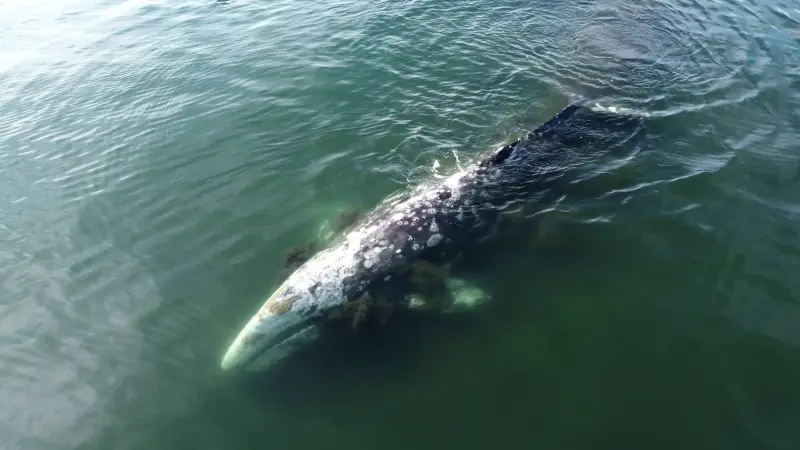
Gray whales migrating to the Kronotsky Gulf rely heavily on bottom-dwelling crustaceans, marine worms, and mollusks to build fat reserves for their extensive annual journeys. The availability and abundance of these food resources determine the specific foraging locations within the gulf, which can shift between different years and even within a single season. Ongoing research in the area is part of a broader conservation initiative dedicated to studying the rare Okhotsk Sea population of this species, supported by the Presidential Fund for Nature.
These marine mammals undertake prolonged migrations between feeding grounds in temperate and high latitudes and breeding areas in tropical and subtropical regions. While in breeding zones, such as the lagoons of the Baja California Peninsula in Mexico, and throughout their migratory routes, the whales consume virtually no food. Instead, they survive entirely on the fat reserves accumulated during their active foraging period in protected waters like the Kronotsky Nature Reserve.
The gray whale is unique among baleen whales in its adaptation to feeding on benthos, extracting sustenance directly from the ocean floor rather than the water column. The survival of the Okhotsk Sea population is intrinsically linked to the stability and productivity of these benthic communities. During the current season, the number of gray whales in the Kronotsky Gulf foraging area is relatively low, with feeding activity concentrated primarily in Olga Bay. The present demographic consists largely of juveniles and females with calves, while solitary adults pass through quickly, likely en route to the coast of Sakhalin or undiscovered feeding grounds depending on the distribution of benthic invertebrates.
Monthly benthic sampling using a manual bottom grab allows for the collection of sediment along with its inhabitants across a designated network of survey points. This material undergoes laboratory analysis at the Kamchatka Branch of the Pacific Institute of Geography to determine the composition, abundance, and mass of the organisms. Preliminary findings identify the cumacean crustacean Diastylopsis dawsoni as a primary food source for the whales in Olga Bay, whereas populations off Sakhalin depend largely on various amphipod species. Gathering sufficient nutrition requires the whales to feed continuously around the clock – a biological necessity that is facilitated by the undisturbed environment of the marine reserve.