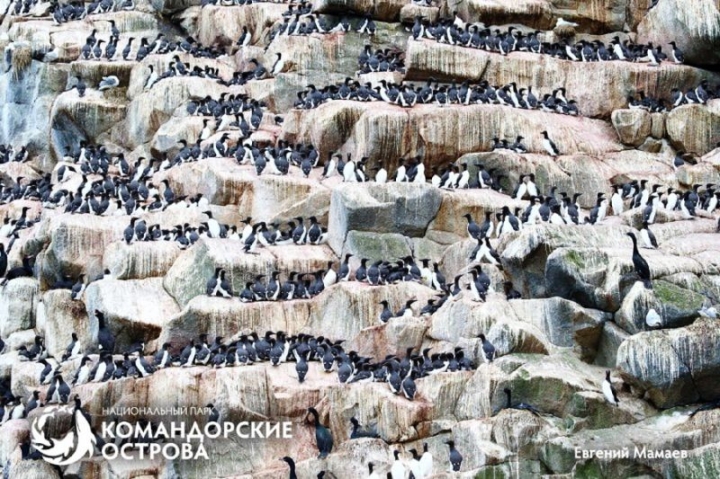
Late May marks a dramatic transformation on Russia’s remote Commander Islands. These rugged, unforgiving Pacific outposts annually become home to one of the world’s most spectacular natural phenomena: colossal seabird colonies. Thousands upon thousands of marine birds return from their wintering grounds, turning the sheer cliffs into a vibrant, cacophonous ‘bird bazaar.’ This annual awakening, described as a “noisy, chaotic, and incredibly lively metropolis” by officials from the Commander Islands National Park, signals the peak of avian life in this critical Arctic and sub-Arctic ecosystem.
Species like common murres (guillemots), black-legged kittiwakes, and various puffins – including the distinctive tufted and horned puffins – converge on every available ledge and crevice. Their collective return transforms the otherwise stark rock faces into a dynamic, living tapestry. Each year, these birds reclaim their ancestral nesting sites, setting the stage for the intense seasonal drama that unfolds on these cliffside nurseries.
The sheer volume of sound is staggering. “The clamour is so immense it drowns out the roar of the surf,” reports the national park. “The air is crisscrossed with wings.” Above the crashing waves, a crucial cycle of life begins: territorial disputes over prime nesting spots, elaborate courtship rituals, and the arduous task of raising new generations. This vibrant spectacle, characterized by constant noise, calls, and ceaseless activity, is how “bird civilization ‘wakes up’” on the Commander Islands, underscoring the islands’ vital role as a biodiversity hotspot and a natural wonder within Russia’s vast geographic reach.