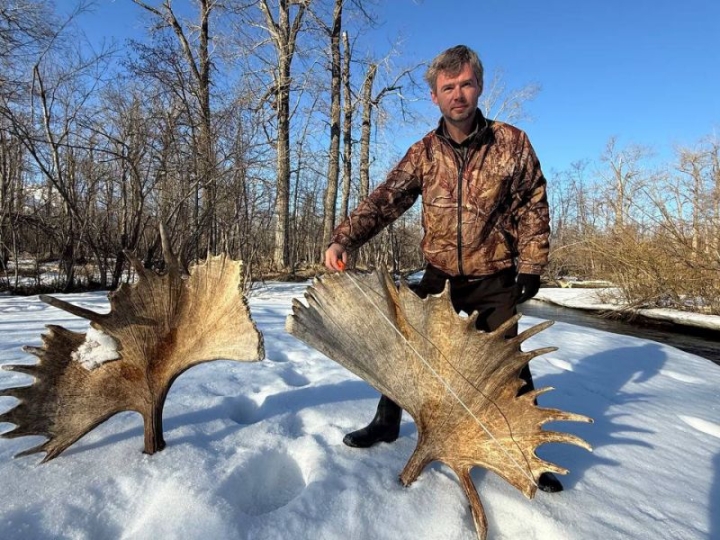
A significant discovery in Russia’s Krontsky Nature Reserve, a jewel within the UNESCO World Heritage site “Volcanoes of Kamchatka,” has captivated wildlife enthusiasts and conservationists alike. Inspectors operating in the reserve’s Lazovsky cluster have unearthed a pair of monumental moose antlers, hailed by experts as a prime example for biological collections and a testament to the region’s thriving ecosystem.
Found along the banks of the Ipuin River, the sheer scale of these antlers immediately stood out. Each palmate beam, or “shovel,” measured over a meter in length, surpassing half the average human height. “We discovered the antlers right on the Ipuin River bank. The area is unmistakably a moose habitat – abundant droppings, tracks of ungulates, and tree branches browsed at considerable heights,” reported Liana Varavskaya, a state inspector at the Krontsky Reserve, underscoring the natural presence of these magnificent animals.
These impressive relics belonged to a robust Kolyma moose (Alces alces buturlini), also known as Buturlin’s moose, which stands as the largest terrestrial mammal inhabiting the Kamchatka Peninsula. An adult male of this subspecies can reach a staggering 2.3 meters at the shoulder, span 3 meters in length, and weigh up to 700 kilograms. Scientific evaluation suggests the antlers were shed by a mature bull in his prime, likely between November and early December, having lain undisturbed throughout the harsh winter.
Vladimir Gordienko, a research fellow at the Krontsky Reserve, highlighted the exceptional quality of the find. “These antlers belonged to a large animal at the peak of its strength. Their form is classic, palmate. The maximum length of palmate antler I have measured was 122 centimeters. Such antlers can weigh around 30 kilograms,” he stated, emphasizing the remarkable proportions and robust health indicated by such a discovery.
The recent history of moose on Kamchatka is a compelling conservation success story, spanning just over five decades. Efforts to reintroduce the species to the peninsula, originating from the Penzhina River basin, commenced in 1976. One of the initial groups of animals was released into the basin of the Left Shchapina River, precisely where the Lazovsky cluster of the Krontsky Reserve was established in 1992. This area has since become the most densely populated moose habitat within the reserve. The first moose were observed in the main territory of the reserve in 1986, steadily expanding their footprint.
The reserve management proudly notes that despite their relatively recent arrival, moose have confidently established their ecological niche. In recent years, their range has expanded, and their population numbers have surged dramatically. While an estimated 100 individuals inhabited the reserve until 2023, winter surveys conducted in 2026 reveal a phenomenal increase to over 700 animals. This remarkable growth underscores the efficacy of protected areas like Krontsky in fostering biodiversity and provides valuable insights for global wildlife conservation strategies. The thriving moose population within this internationally recognized natural heritage site serves as a beacon of hope for species reintroduction and habitat management worldwide.