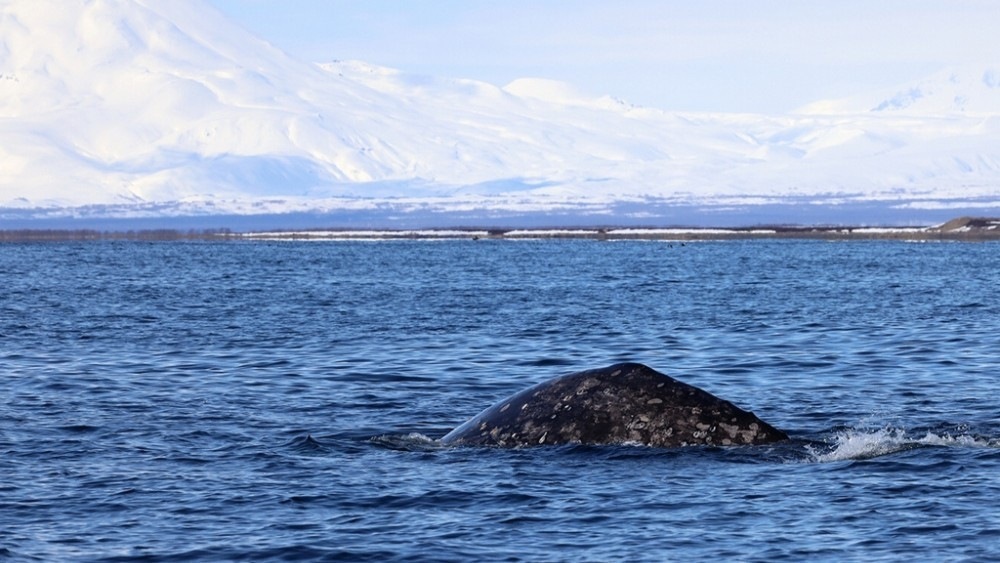
Gray whales, the magnificent giants of the Pacific, have successfully concluded their epic southbound migration from their breeding grounds off the Baja California Peninsula, congregating once more in the rich waters of Kronotsky Bay on Russia’s Kamchatka Peninsula. This monumental journey spans approximately 8,000 kilometers across the vast Pacific Ocean, bringing these marine mammals to their traditional northern feeding grounds for the summer season. The first intrepid individuals were spotted by shore-based biologists as early as April 19th, marking the beginning of their annual return to this critical Arctic ecosystem.
Despite challenging weather conditions that initially hampered offshore operations, scientists were able to commence comprehensive marine monitoring by the end of April. This year, researchers have set a new precedent, launching their vital fieldwork earlier than ever before. “We have already conducted three gray whale counts along our route from Olga Bay to the Kronotsky Liman estuary – a stretch of about thirty kilometers along the coast,” reported Evgenia Volkova, a researcher at the Kronotsky State Reserve. She added, “This year, we set a record: we’ve never managed to get out to sea so early.” Traditionally, navigation for monitoring would only begin in early May when larger numbers of whales had gathered, but this year’s early start allowed scientists to observe the “vanguard” of the migration – the first whales to reach the peninsula.
Over three separate marine expeditions, researchers successfully identified and documented nine individual gray whales. The initial patrol encountered three distinct animals, followed by five more during the second trip, with only one of these being a repeat sighting. A third excursion yielded encounters with two additional whales. Visual assessments revealed that the whales, as expected after such a demanding transit, appeared emaciated. This physical state is a normal physiological response to the lengthy journey and the energy expenditure involved in their survival.
All observed whales are already cross-referenced within the comprehensive Kamchatka catalog, providing crucial data for ongoing research. Among them were five adult females, two of whom had given birth last year, two males, and two individuals whose sex is yet to be determined. Notably, eight of these identified whales are also recognized by specialists in Sakhalin, underscoring the shared migratory pathways and the potential for regional scientific collaboration in tracking these globally significant populations. One male, cataloged as K008, stood out, bearing fresh scars from orca teeth – a stark testament to the ever-present dangers and predatory encounters faced during its arduous Pacific crossing, and a reminder of the wild, untamed nature of marine life.
While these initial arrivals signify the commencement of the feeding season, the primary influx of gray whales into the protected waters of Kronotsky Bay is traditionally anticipated throughout May. The migration unfolds in distinct phases: initially, males, younger whales, and pregnant females reach the rich feeding grounds. Later in the season, mothers with calves born during the winter months arrive in Kamchatka. This delay allows vital time for the newborn calves to gain sufficient mass and strength before embarking on their own multi-month journey, highlighting the intricate biological rhythms that govern these magnificent marine migrations and the global imperative to protect their critical habitats.