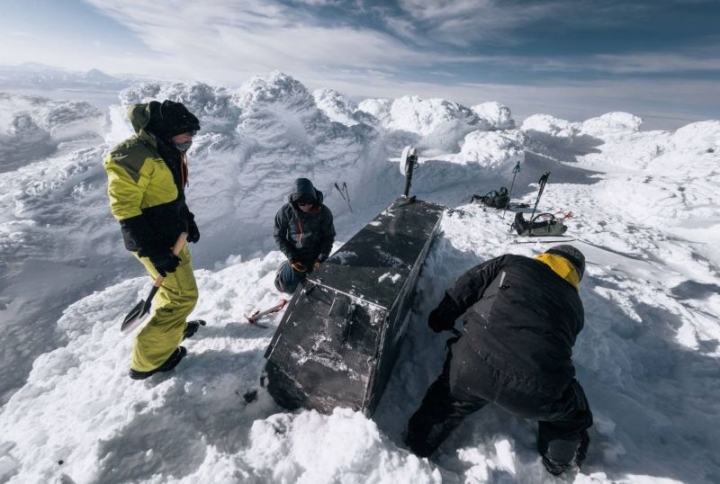
In a challenging high-altitude operation, Russian scientists have successfully conducted vital maintenance on an experimental volcanic monitoring complex stationed atop Avachinsky volcano in Kamchatka. This remote and strategically significant peninsula, part of the Pacific Ring of Fire, is a hotbed of seismic and volcanic activity, making continuous monitoring crucial not only for regional safety but also for broader international understanding of geological hazards.
Specialists from the Institute of Volcanology and Seismology (IViS) of the Far Eastern Branch of the Russian Academy of Sciences ascended the 2,741-meter peak to service the Volcanological Multiparameter Automatic Complex (VMAC), an innovative autonomous station crucial for real-time data collection. Installed in late August 2025 at an elevation of 2,727 meters on the volcano’s lava plug, the VMAC had experienced operational disruptions due to the extreme conditions. The team braved icy winds and snow to clear its solar panel, restore battery charging capabilities, and re-establish data transmission from its broadband seismic station, ensuring the complex’s continued functionality.
The VMAC represents a significant leap in volcano observation technology, providing continuous, multi-parameter monitoring capabilities essential for forecasting eruptions. By collecting real-time seismic, deformational, and gas-geochemical data, the system offers critical insights into the internal processes of Avachinsky, one of Kamchatka’s most active volcanoes. Such advancements in predictive science have global implications, contributing to aviation safety, disaster risk reduction, and fundamental geological research, areas where international collaboration and data sharing are increasingly vital to address shared planetary challenges.
This demanding fieldwork underscores Russia’s ongoing commitment to scientific exploration and hazard mitigation in its Far Eastern territories. The successful maintenance of this experimental complex not only strengthens regional preparedness but also contributes valuable data to the global scientific community’s collective efforts to understand and predict the powerful forces shaping our planet. As technology continues to evolve, high-altitude research facilities like the VMAC are poised to play an increasingly critical role in safeguarding populations and informing international strategies for natural disaster resilience.