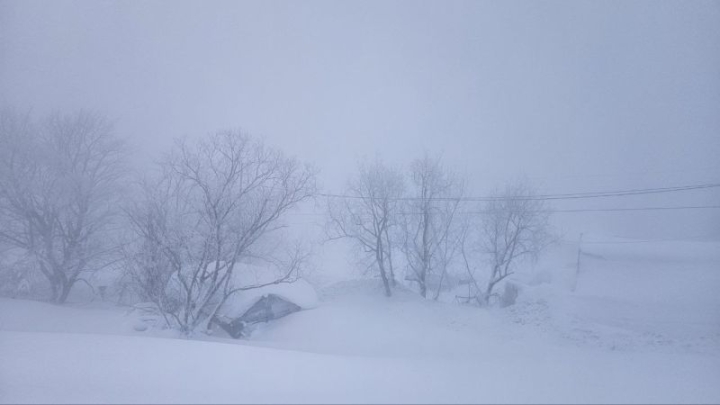
Petropavlovsk-Kamchatsky, a strategically vital port city in Russia’s remote Far East, woke this morning to a breathtaking yet perilous spectacle as a dense icy fog enveloped its historic center. The powerful atmospheric phenomenon, locally known as frosty or ice fog, transformed the urban landscape into an ethereal, obscured realm, rendering iconic landmarks such as Kultuchnoye Lake, Nikolskaya Sopka, and the expansive Avacha Bay completely invisible.
This ‘ice fog’ is a specialized meteorological event, unique to conditions of extreme cold. Unlike typical fog, which consists of liquid water droplets, icy fog is composed of minuscule ice crystals suspended in the air. It forms when temperatures plummet significantly, usually below -10 to -15 degrees Celsius (14 to 5 degrees Fahrenheit). As these microscopic crystals make contact with roads, power lines, and trees, they instantly freeze, creating a treacherous layer of ice that can quickly encase surfaces.
The implications of such freezing fog are severe, posing a substantial threat to public safety and regional infrastructure. The rapid accumulation of ice can paralyze transportation networks, leading to hazardous driving conditions, increased risk of accidents, and potentially isolating communities in an already challenging environment. For a region critical to maritime activity and regional logistics, this disruption carries significant weight.
The onset of the extreme cold follows in the wake of a powerful cyclone that recently swept across the southern part of the Kamchatka Peninsula, leaving behind a dramatic and sharp drop in temperatures. Forecasts from the Kamchatka Hydrometeorological and Environmental Monitoring Department indicate that temperatures in the southern districts are expected to plunge to between -25 and -30 degrees Celsius (-13 to -22 degrees Fahrenheit) today and tomorrow. Even more extreme conditions are anticipated in the northern reaches of the peninsula, where nighttime temperatures could reach a staggering -40 degrees Celsius (-40 degrees Fahrenheit).
This deep freeze underscores the harsh climatic realities faced by residents and industries in Russia’s subarctic and arctic territories, highlighting the ongoing challenges of maintaining operations and ensuring safety in one of the world’s most extreme regions, a crucial outpost on the Pacific rim.