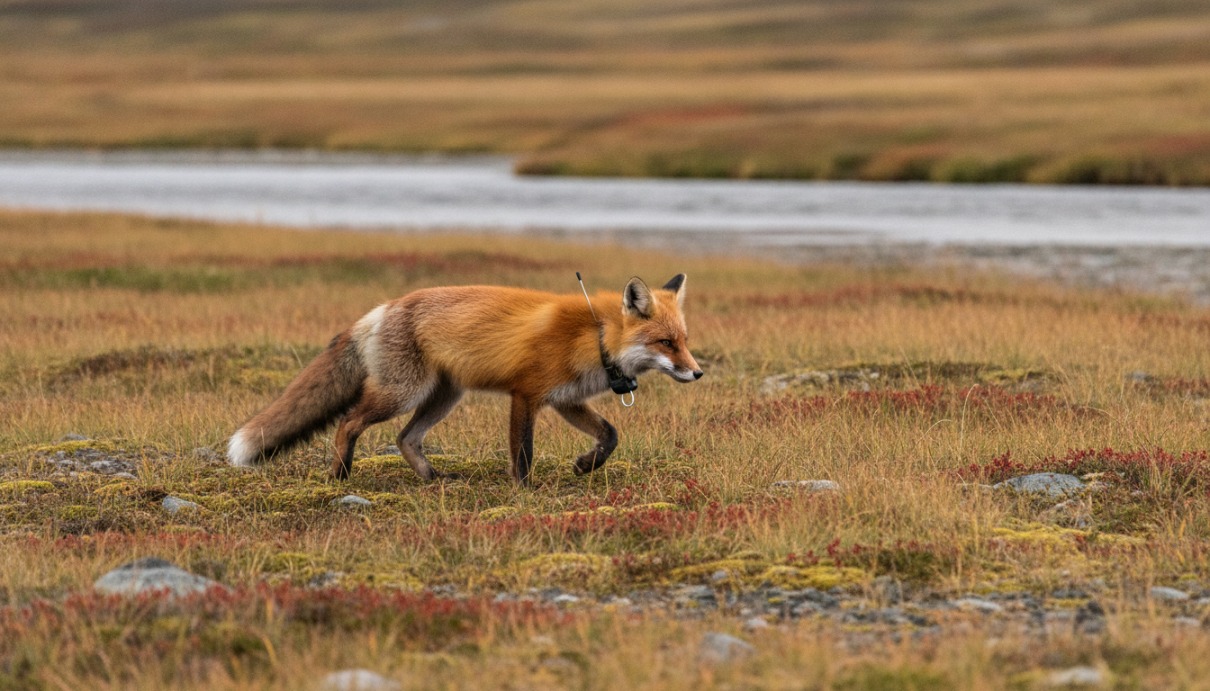
Researchers at the Kronotsky State Nature Reserve in Kamchatka have analyzed the results of the reserve’s first study of fox behavior using wearable sensors and video recording. During the summer, scientists sequentially fitted a fox with a miniature action camera and a GPS collar to map its travel routes and examine its daily activity patterns.
The study was conducted in a section of coastal tundra near the Aerodrom ranger station, where the reserve’s fox population density is highest. According to Alexander Shienok, a senior researcher and mammalogist at the reserve, the capture of the animal and installation of the equipment were carried out in coordination with Russia’s Federal Service for Supervision of Natural Resources (Rosprirodnadzor) and in compliance with environmental legislation.
The subject of the study was a female fox named Victoria. District state inspector Konstantin Lepsky said the animal received the name after driving away a wolverine that had attempted to take food supplies at the ranger station. Although the fox was accustomed to human presence near the buildings, capturing her in a cage trap took multiple attempts. Following the completion of the observations, the fox continued to visit the station regularly.
During the first phase of the research, the fox was fitted with a collar carrying a lightweight action camera equipped with infrared illumination. The device did not impede the animal’s movement and provided the first-ever view of the interior structure of a fox den. Shienok noted that the burrow proved to be deep, a feature that helps foxes evade bears and wolves. Nighttime footage also captured the predator’s foraging behavior, showing the fox moving through the dark with its muzzle lowered, sniffing the ground, and preying on a bird egg and a wader chick.
In late July, the camera was removed and replaced with a collar containing a GPS tracker and an accelerometer, which remained on the animal until September 10. The satellite sensor recorded coordinates every two minutes, while the accelerometer logged overall motor activity every five seconds. Analysis of the collected data showed that the fox’s home range spans several kilometers and includes at least three resting dens.
The predator’s movement patterns shifted over time. Shortly after the tracker was fitted, the fox began venturing frequently into forested areas – presumably in search of voles. Starting in late August, her travels became noticeably longer, and she eventually swam across the Kronotskaya River to roam along the opposite bank. Data from the accelerometer confirmed the camera observations – the animal exhibited peak activity at night.
Using video collars and satellite trackers enables zoologists to obtain precise data on the diet, territorial boundaries, and circadian rhythms of wild animals without direct human interference in their daily lives.