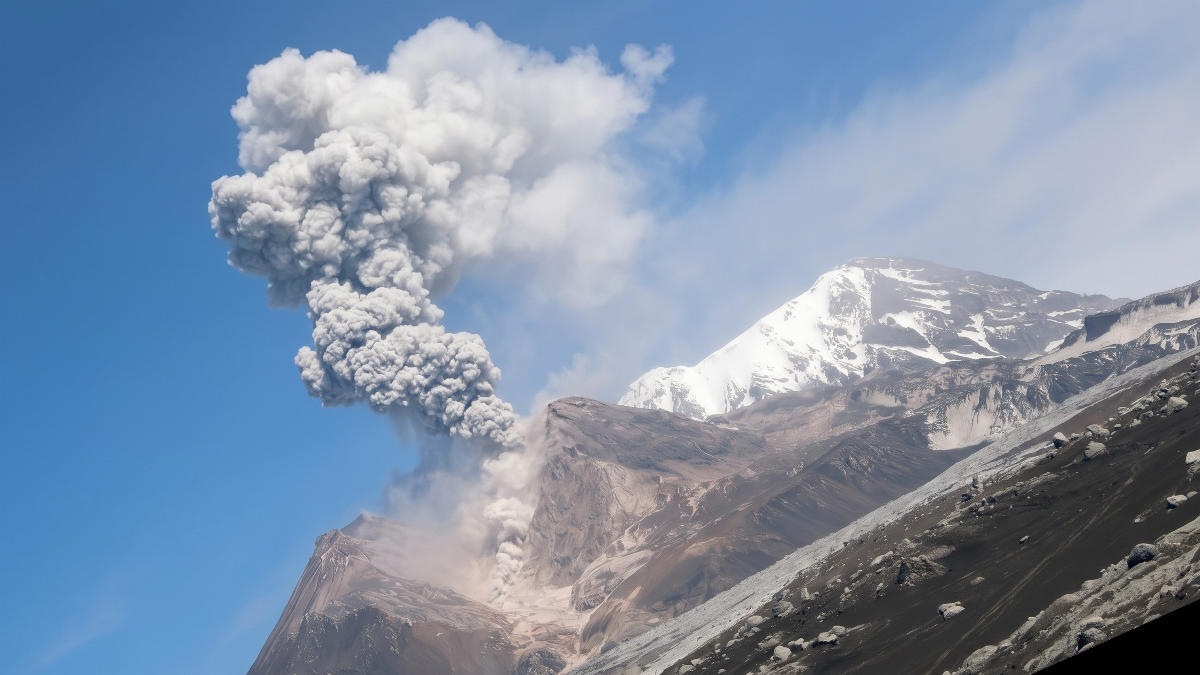
The Shiveluch volcano in Kamchatka remains the most unpredictable in the region and could begin an explosive eruption at any moment. On Monday morning, the volcano emitted an ash column reaching approximately six kilometers above sea level, as recorded by cameras from the Kamchatka branch of the Unified Geophysical Service of the Russian Academy of Sciences.
Lava domes continue to extrude within the crater of the volcano. According to Olga Girina, head of the Kamchatka Volcanic Eruption Response Team, it is currently impossible to predict exactly when and where a new block of lava will emerge or when the next powerful explosion will occur.
In the spring, scientists discovered a new lava dome on the slope of Old Shiveluch, which was named 300 Years of the RAS. Following a series of eruptions in August, September, and November, the activity of this specific dome subsided. However, the dome of Young Shiveluch has since awakened. Since the beginning of the year, periodic explosive events have occurred at this site, sending ash to heights of 10–11 kilometers.
Volcanologists do not anticipate a repeat of the large-scale 2023 eruption in the immediate future. During that event, a giant dome that had been forming for two decades collapsed, depositing nearly ten centimeters of ash on the neighboring village of Klyuchi over three days. The current dome is still small but continues to expand. The influx of magmatic material requires new channels to reach the surface – these pathways are created by isolated strong explosions, allowing the volcano to build mass.
Shiveluch is the northernmost active volcano in Kamchatka, located within the Eastern Range. Its absolute elevation reaches 3,283 meters. The volcano is situated 47 kilometers from the nearest settlement – the village of Klyuchi – and 440 kilometers from Petropavlovsk-Kamchatsky.