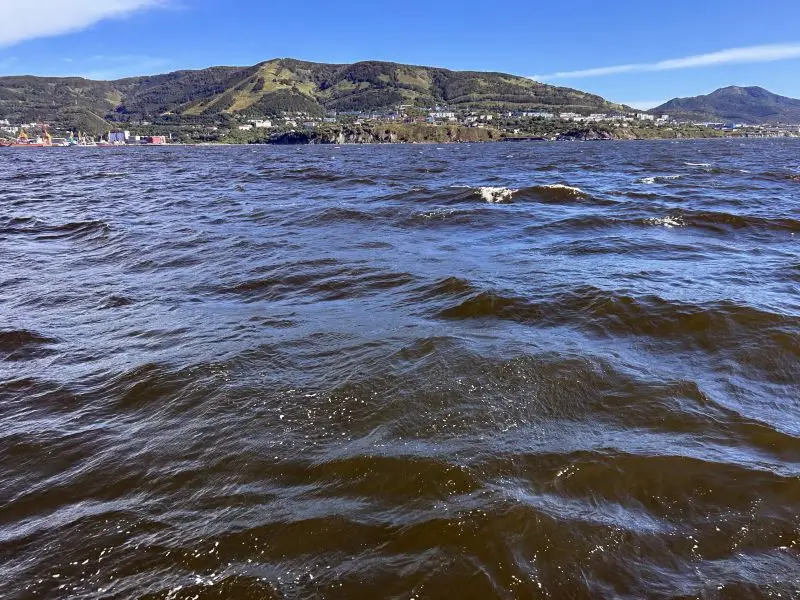
Mid-September environmental phenomena in Kamchatka’s Avacha Bay, including large accumulations of starfish along the city embankment and Seroglazka Bay alongside nighttime bioluminescence, are the direct result of harmful algal blooms and localized marine pollution. Comprehensive ecological monitoring of the bay focuses heavily on the marine organisms responsible for these recurring red tides.
The primary bloom-causing organisms in Avacha Bay include diatoms of the genus Pseudo-nitzschia – a known source of amnesic toxins – and the dinoflagellate Alexandrium catenella, which produces saxitoxin and related neuroparalytic toxins. Extensive strips of these blooms reappeared throughout the bay in September. Areas of reddish water, caused by dense accumulations of Alexandrium cells, alternated with mustard-colored bands. This mustard hue is produced by Skeletonema diatoms, which concentrate in these bloom patches at densities reaching hundreds of millions of cells per liter.
The proliferation of Skeletonema has a documented negative impact on certain groups of echinoderms and can directly cause mortality among starfish populations. Furthermore, spatial surveys of the beaches along the Ozernovskaya Spit and Seroglazka Bay indicate that the massive wash-ups of deceased starfish are consistently localized around the discharge points of municipal sewage collectors.