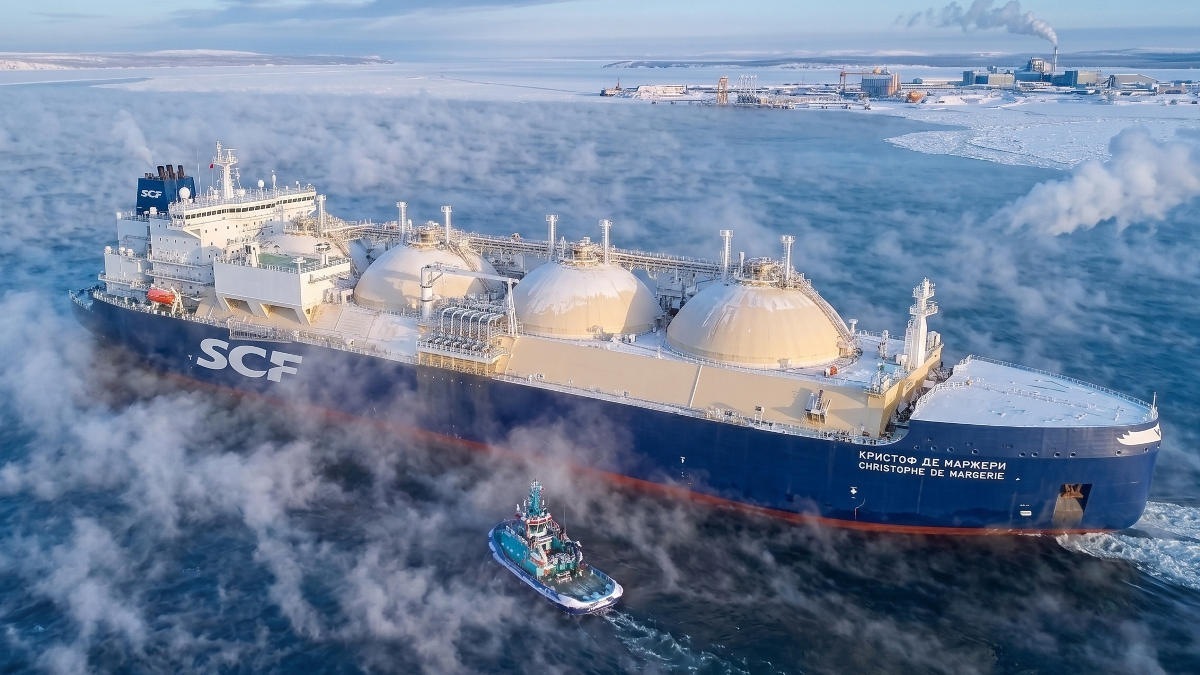
In a move underscoring Russia’s burgeoning Arctic energy ambitions, the ice-breaking tanker Christophe de Margerie has successfully completed its inaugural voyage of the navigation season, delivering a consignment of liquefied natural gas (LNG) from the Arctic LNG-2 plant on the Yamal Peninsula. The vessel traversed the Northern Sea Route (NSR) in just over two weeks, offloading its cargo at the floating storage unit (FSU) “Koryak FSU” strategically positioned off the coast of Kamchatka. This operation, orchestrated by Russian energy giant Novatek, marks a significant step in establishing a robust energy corridor connecting Russia’s vast Arctic resources with burgeoning markets in the Asia-Pacific region.
The logistical strategy behind this new hub is designed for optimal efficiency. The “Koryak FSU” acts as a crucial transshipment point, allowing for the transfer of LNG from specialized ice-class vessels, like the Christophe de Margerie, to conventional tankers for onward journeys. This system is already operational, with the tanker Arctic Mulan poised to transport its share of Yamal gas to China. By centralizing transshipment in Kamchatka, Russia aims to maximize the operational time of its high-value icebreaker fleet within the challenging Arctic environment, preventing them from making lengthy voyages to warmer waters and thereby enhancing the overall commercial viability of the NSR.
This pivotal energy hub is situated in Bechevinskaya Bay, approximately 200 kilometers from Petropavlovsk-Kamchatsky, a location steeped in history. The bay once housed Finval, a closed Soviet military town known as Petropavlovsk-54, which served as a crucial base for a flotilla of diesel submarines during the Cold War. Despite its strategic past, the area presented significant engineering challenges, including constant sand deposition at the bay’s entrance, necessitating continuous dredging operations. Following the dissolution of the Soviet Union, the military infrastructure fell into disrepair, and the settlement became largely abandoned.
The transformation of Bechevinskaya Bay into a modern energy terminal was initiated five years ago with substantial state financial backing. Preparatory work, including engineering surveys conducted by Chinese specialists, commenced in 2020. This was followed by extensive dredging efforts in 2021, where hundreds of thousands of tons of sand and rock were removed to restore a six-kilometer fairway. The culmination of these efforts saw the non-self-propelled FSU “Koryak,” with a displacement of half a million tons, towed into the bay from South Korea in 2023, ready to serve as the region’s primary LNG accumulator.
Beyond its role in international export, this sophisticated logistical complex is also intended to address critical energy deficiencies within the Kamchatka Krai itself. The peninsula has long grappled with a fuel shortage for its thermal power plants. Currently, fuel oil accounts for a substantial 36 percent of Kamchatka’s energy balance, overshadowing indigenous natural gas (27 percent), coal (14 percent), and geothermal sources (13 percent). Local gas production has consistently fallen short of projections, despite significant investments in a gas transportation network across the region.
To mitigate this domestic energy crisis, plans are underway for the construction of a specialized berth in Rakova Bay, Petropavlovsk-Kamchatsky. This new infrastructure will facilitate shuttle deliveries from the “Koryak FSU” using two dedicated gas carriers and a floating regasification unit. This initiative is projected to provide the region with over 600 million cubic meters of gas annually, enabling a crucial shift away from fuel oil at Kamchatka’s primary power generation facilities, TPP-1 and TPP-2.
The development of this transshipment hub extends its positive ramifications to broader regional development. A new fiber-optic communication line has already been laid to the former military settlement, significantly enhancing connectivity. The operational complex is expected to generate approximately 100 new jobs, providing a much-needed economic stimulus. Furthermore, the presence of these specialized energy companies will bolster the regional budget through tax revenues and is anticipated to catalyze an increase in cargo traffic along the Northern Sea Route, reinforcing Russia’s strategic position in global energy trade and Arctic development.