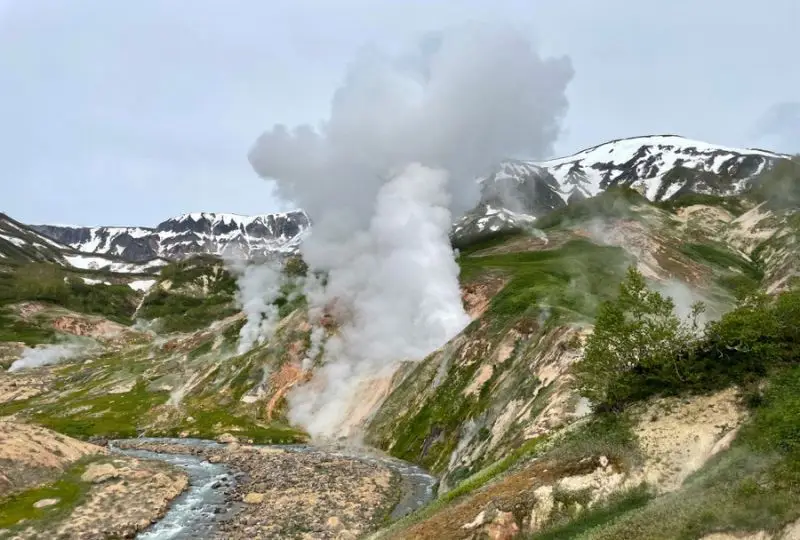
Unusual behavior observed in the Valley of Geysers in Kamchatka preceded a major earthquake that struck the region on July 30 of last year. Grot, the most powerful geyser in the Kronotsky Nature Reserve, ceased its eruptions exactly three months prior to the seismic event. Before falling silent, the geyser had maintained a consistent pattern of high activity for several years.
This sudden inactivity indicates the conclusion of a local seismic cycle. The typical interval for energy accumulation between the most severe earthquakes in Kamchatka spans 70 to 80 years. Based on this timeline and the geyser’s behavioral shift, there is a lower probability of similar large-scale natural disasters occurring in the territory in the immediate future.
The earthquake in question occurred in the Pacific Ocean, roughly 149 kilometers from Petropavlovsk-Kamchatsky. Registering a magnitude of 8.8, the event is categorized as a mega-earthquake – a classification reserved for seismic events exceeding a magnitude of 8.0. This magnitude makes it the most powerful earthquake recorded in the region since 1952. Residents in multiple settlements across the territory experienced significant tremors reaching an intensity of up to 8 on the local seismic scale.