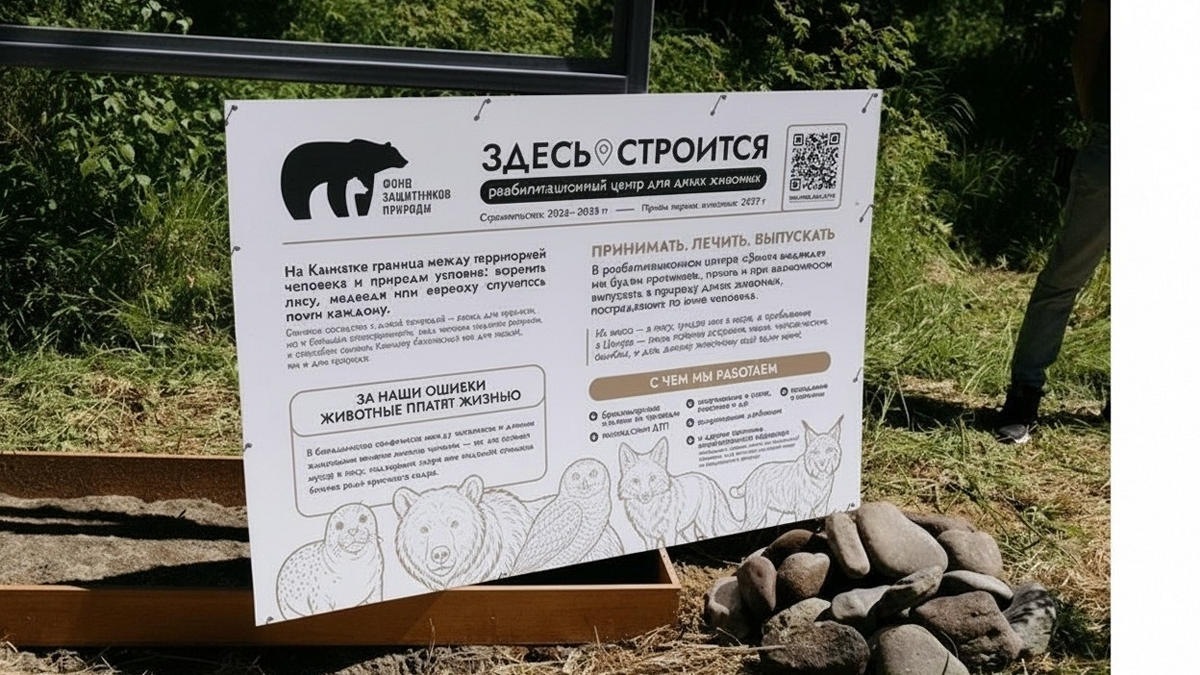
Construction has begun on the Land of the Bear wildlife rehabilitation center in Kamchatka. A 65-hectare site has been allocated near the Pinachevsky cordon of the Volcanoes of Kamchatka Nature Park. The privately funded project focuses on treating animals and birds injured by human activity and returning them to the wild.
Experts selected the territory based on its distance from populated areas, the availability of water bodies, and its proximity to protected zones. The first phase of the project will develop approximately five hectares. Construction crews will build spacious enclosures, a feed kitchen, and staff housing, avoiding massive structures. With documentation nearing completion, initial building work is scheduled to finish by the end of this year, while the full opening of the complex is scheduled for 2027.
The creation of the complex was initiated by the Nature Defenders Fund with support from the regional government. The scope of the center extends beyond veterinary care to focus significantly on changing human attitudes toward the environment. Statistics indicate an increase in human-predator conflicts compared to the Soviet period. This rise is driven by expanding human activity in forests and the proliferation of illegal waste dumps. Wild animals become habituated to accessible food waste and approach populated areas – a situation that frequently results in the culling of the animal or human casualties.
To mitigate such incidents, the project team collaborated with teenagers from the Ecosystem. Zapovedny Krai environmental forum to install information boards. Signage detailing the rules of behavior when encountering predators has been placed along the banks of the Avacha River and at the Pinachevsky cordon. This location marks the beginning of a popular hiking trail leading to the central part of Nalychevo Park, where travelers regularly encounter bears.
The future facility will not function as a zoo or a lifelong animal shelter. It will admit foxes, lynxes, seals, and birds that have been struck by vehicles, injured by poachers, or entangled in fishing nets. Animals will remain in enclosures permanently only in exceptional cases – specifically, if they are physically incapable of surviving in the wild.
Special attention will be given to orphaned bear cubs. Kamchatka ecologists will employ methodologies developed by the Orphan Bear Rescue Center in the Tver region. This approach prevents the animals from becoming habituated to humans. The cubs will be cared for by two to three staff members wearing heavy protective suits. During feeding, all speech and tactile contact are strictly prohibited, and any attempts by the animals to approach handlers will be firmly stopped. This ensures the bears retain their natural fear of humans.
Every animal released into the forest will be equipped with a tracking sensor. This technology allows for the monitoring of their movements and enables a rapid response if they approach urban areas. The effectiveness of this approach has been demonstrated over thirty years in the Tver region, where more than three hundred bears have been returned to the wild without a single individual becoming synanthropic.
Veterinary support for the Kamchatka project will be provided by the Crocodile clinic. Organizers are currently assembling a staff of wildlife biologists, ecologists, and protected area inspectors. In the long term, the fund plans to train its own personnel from among the local youth.