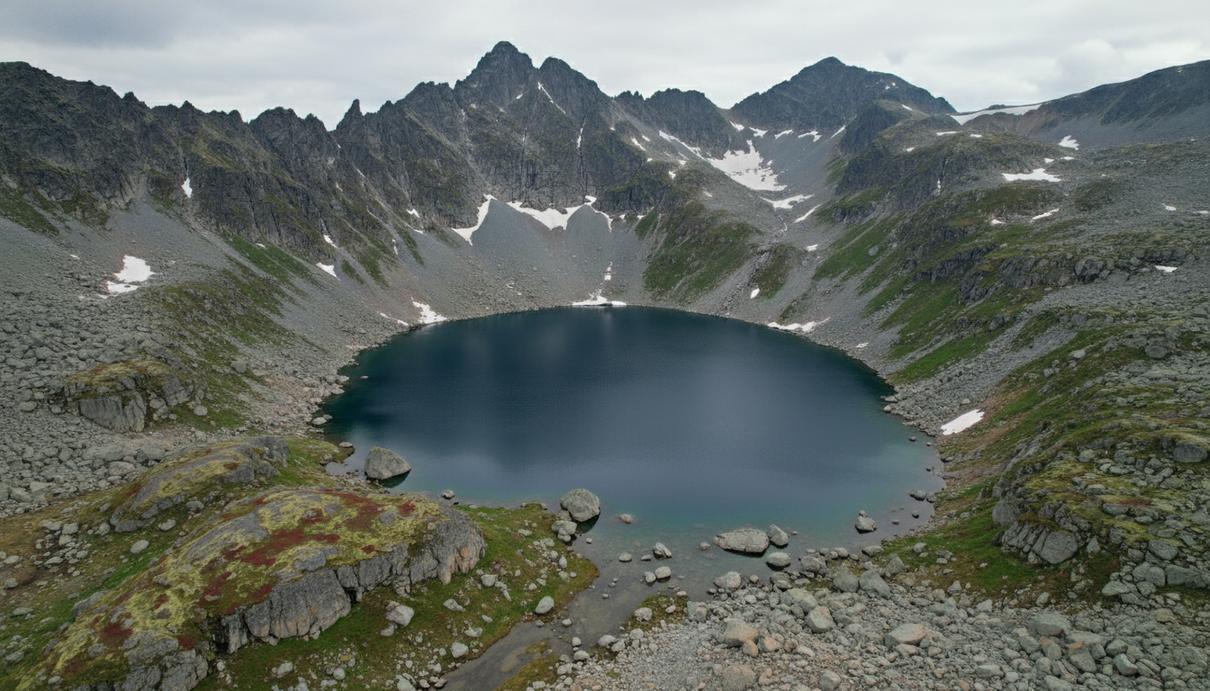
In a significant scientific breakthrough from Russia’s remote Kamchatka Peninsula, researchers have uncovered an isolated fish population exhibiting anatomical traits never before observed. This extraordinary discovery, made by scientists from the Russian Academy of Sciences and Kamchatka State University within the Bystrinsky Natural Park, near the iconic Icha volcano, sheds new light on the power of evolution in extreme isolation.
The unique habitat — a secluded, high-altitude lake system cut off from the main Bystraya-Khairyuzovskaya River by impassable rapids and ancient glacial moraines — has served as a natural laboratory for millennia. Geologists suggest the primary reservoir, Lake Rybnoe, with its depths reaching nine meters and spanning five hectares, likely originated from glacial activity. It was this prehistoric geological event, trapping the ancestors of these fish as glaciers receded, that set the stage for their unparalleled evolutionary journey.
The char species found in this pristine environment has developed cranial structures previously unknown to ichthyology, presenting a significant puzzle to researchers. Experts note the emergence of a distinctive cartilaginous plate positioned anterior to the eye orbits, along with a massive lateral crest on the suspensorium bone. Furthermore, the sensitive elements of their lateral line system, crucial for detecting movement and pressure changes in water, have dramatically shifted outwards, a stark contrast to their relatives where these are typically encased within a specialized canal.
Scientists are now undertaking intricate molecular-genetic analyses to unravel the mystery behind these profound alterations. The research aims to determine whether these deviations represent a series of random mutations that have persisted over millennia, or a sophisticated evolutionary adaptation, perhaps enabling the fish to forage more efficiently for food within the lake’s liquid bottom silt. The findings could offer invaluable insights into the mechanisms of speciation and adaptation in isolated ecosystems worldwide.
Adding to the region’s remarkable biodiversity, the expedition also identified another relic species, Kokanee — a landlocked form of sockeye salmon — in Lake Nochnoye, located further down the gorge. This population, which has adapted to a purely freshwater existence, exhibits slow growth, with individuals reaching only up to 200 grams, and subsists exclusively on zooplankton. Similar landlocked salmon forms have been documented in other Kamchatkan lakes, including Kronotskoye, Podsopochonoye, and Utinoye, each displaying its own unique feeding strategies and evolutionary paths.
The comprehensive biological data collected during these field expeditions are poised to become the cornerstone of new, targeted conservation strategies for these rare species. This extensive project, a collaborative effort between the Russian Academy of Sciences, Kamchatka State University, and the ‘Volcanoes of Kamchatka’ Natural Park, is integral to a broader initiative dedicated to studying and preserving the peninsula’s unique natural heritage. The identification of previously unknown populations in these challenging, remote aquatic environments is crucial for environmentalists globally, enabling more precise and effective protection regimes for some of the planet’s most invaluable and isolated ecosystems.