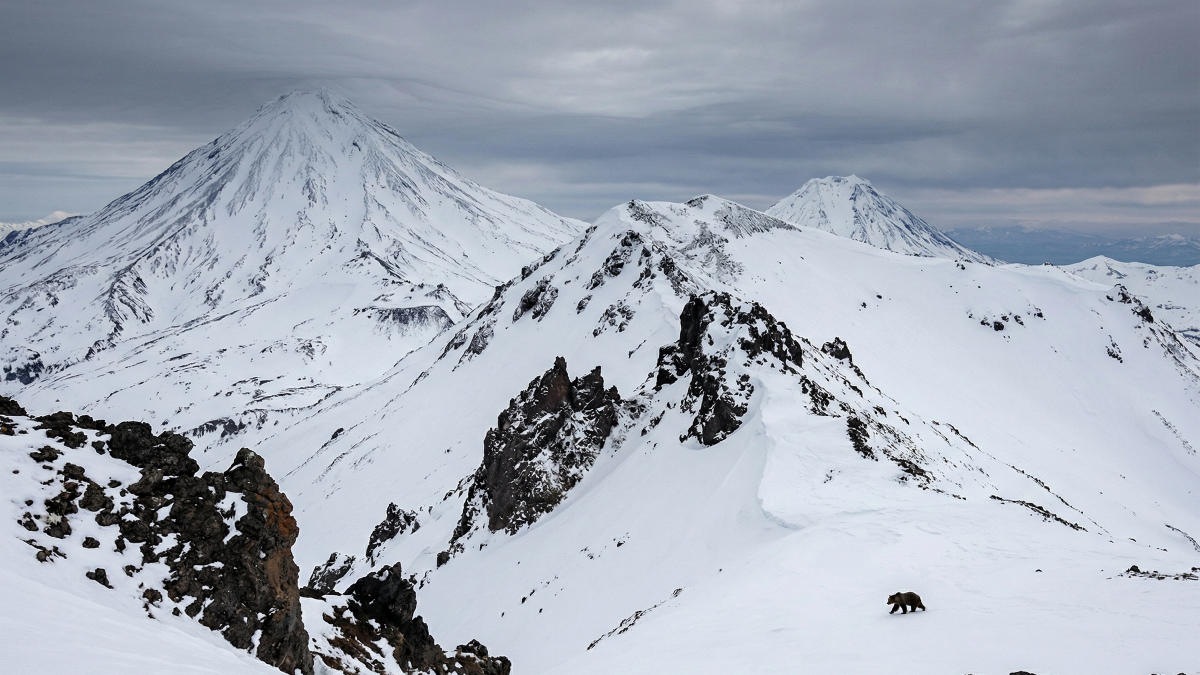
Heavy snowfalls are significantly altering the natural rhythm of life on Russia’s remote Kamchatka Peninsula, postponing the emergence of local wildlife from hibernation. Experts warn that this unusual climatic event could have far-reaching implications for the region’s delicate ecosystem. Evgeny Karpov, a leading specialist from the monitoring department of the “Volcanoes of Kamchatka” natural parks network, anticipates an uneven delay, with specific areas experiencing varying impacts. Typically, marmots awaken in early to mid-May, but Karpov predicts that those near Mutnovsky Volcano might not surface until June this year, while bears are expected to emerge closer to late April or early May. This shift highlights the immediate effects of extreme weather patterns on biodiversity in one of the world’s most pristine wildernesses.
Karpov, who has dedicated years to observing a model colony of black-capped marmots on the slopes of Koryaksky Volcano at an altitude of 1,200-1,300 meters, points to the species’ precarious existence. Their population dynamics are highly volatile, experiencing sharp increases in mortality during unfavorable conditions and rapid reproduction with three to four offspring per litter in more benign periods. A striking legal paradox further complicates their conservation: despite being listed in Russia’s federal Red Book as an endangered species, the black-capped marmot is not included in Kamchatka’s regional Red Book. This discrepancy effectively legalizes hunting for the species on the peninsula, allowing hunters to obtain licenses freely. Karpov highlights this legal conflict, noting that while these rodents inhabit inaccessible lava fields and rocks, safeguarding them from natural predators, uncontrolled hunting poses a severe threat to the region’s unique biodiversity. This situation underscores a broader challenge in balancing federal conservation mandates with regional practices.
The protection of Kamchatka’s vast natural territories is severely hampered by a critical shortage of personnel. Karpov reveals that hundreds of thousands of hectares within the natural parks are currently overseen by a mere few dozen individuals. “The staffing plan calls for 180 inspectors for an area of this size. In reality, our institution has only 45 staff members in total, with just about 20 of them serving as inspectors,” Karpov explains. The dire staffing levels are primarily attributed to low salaries, which result in high turnover rates. While former military personnel and police officers often join the ranks, few remain long-term, creating a perpetual struggle to maintain adequate oversight and enforcement in these crucial protected areas. This systemic weakness raises concerns about the long-term viability of conservation efforts in such biodiverse but remote regions.
At 66 years old, Evgeny Karpov exemplifies the deep, personal commitment often required in conservation work. He continues his demanding role, driven largely by the absence of trained successors. His responsibilities extend from planning complex expeditions and handling cartography and navigation to operating drones, for which he earned official certification a year ago after five years of self-taught practice. “We need to train new personnel. But how, when everyone comes and goes… I have a pension, and a salary. Money doesn’t interest me as much as it does the younger generation. That’s why I truly enjoy my work,” Karpov states with quiet determination. His unwavering dedication highlights the critical role of experienced individuals in bridging severe resource gaps and maintaining essential conservation activities amidst systemic challenges.
A significant aspect of the monitoring efforts revolves around Kamchatka’s iconic bear population. Winter surveys involve tracking other active animals like sables, foxes, wolves, and stoats, with bear numbers assessed only after they emerge from their dens. Inspectors often recognize individual bears inhabiting areas near ranger stations. However, a darker consequence of human presence emerges when tourists habituate bears to human-provided food. Such animals become a direct threat and often must be culled to ensure public safety, illustrating the perilous interface between human activity and wildlife.
Karpov’s extensive experience has taught him a pragmatic approach to bear safety, emphasizing that bears rarely show aggression without provocation. He advises maintaining a distance of 15-20 meters and making loud noises to avoid conflict. He recounts an instance where a bear approached a group within 30 meters and stood on its hind legs, compensating for its poor eyesight, only to retreat after sharp shouts. More often, dangerous situations are instigated by humans. In one notable incident, tourists in an off-road vehicle chased a bear directly towards a group of researchers; a quick-thinking dog, barking fiercely, diverted the animal, narrowly averting a confrontation. When it comes to so-called “man-eater” bears, Karpov holds a stark view: individuals that actively hunt humans change their behavior irrevocably, leaving virtually no chance of survival in an attack. The only immediate solution in such dire circumstances, he insists, is the humane culling of the animal.
Life in Kamchatka’s wilderness often presents both perils and peculiar moments. Karpov recalls a memorable incident from the late 1980s in the Olyutorsky District, where a student from an expedition group climbed a birch tree to photograph a bear cub. The mother bear promptly appeared and shook the tree, causing the cub to fall, after which both bears disappeared. The student, paralyzed by fear and cramps, remained stuck in the tree. The group ultimately had to fell the trunk and transport the young man, still clinging to the birch, in the back of an all-terrain vehicle. Such tales, Karpov notes, are simply part of the routine. His ability to maintain composure and his profound understanding of wild animal behavior have allowed him to patrol these territories for decades, effectively filling staffing gaps and sustaining his deep passion for the profession, safeguarding Kamchatka’s natural heritage against numerous odds.