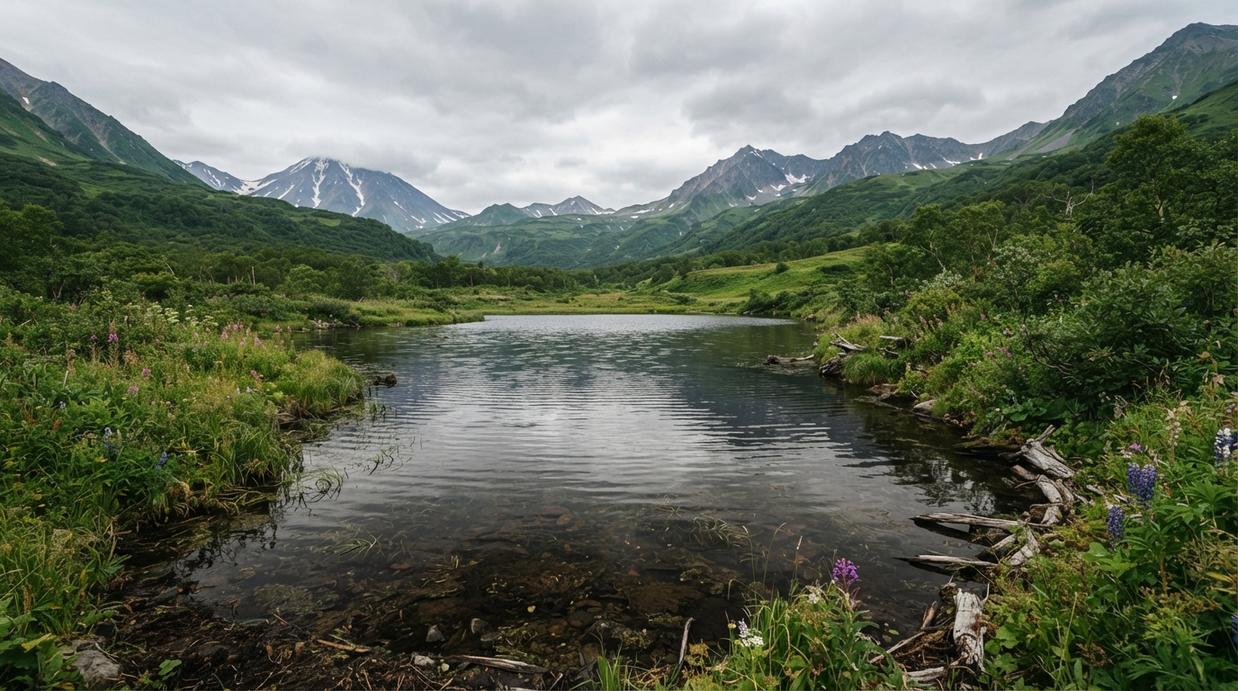
Researchers from the Siberian Branch of the Russian Academy of Sciences reconstructed the climate history of southern Kamchatka over the past 1,200 years. The chemical composition of bottom sediments from Lake Chasha was analyzed using X-ray fluorescence spectrometry powered by synchrotron radiation.
The soil composition at the bottom of freshwater bodies responds sensitively to environmental changes. Elevated levels of titanium, gallium, and rubidium paired with low bromine indicate fluctuations in temperature and humidity, whereas calcium and strontium concentrations reflect variations in salinity. Bromine served as the key marker in this research – acting as an indicator of the volume of organic matter that settles on the lakebed during the vegetative period from May to September.
Scientists from the Institute of Geology and Mineralogy, alongside the Institute of Nuclear Physics, matched these physical parameters with archival meteorological data. The bromine levels in the sediment layers of Lake Chasha directly correlate with summer air temperatures across the peninsula.
An analysis of the extracted sediment core with annual resolution revealed distinct climatic cycles. Spectral analysis identified a significant periodicity in temperature fluctuations at intervals of approximately 88 years, alongside shorter cycles lasting between three and four years.
The climate of Kamchatka is driven by the macroregional dynamics of the North Pacific Ocean. Temperature shifts on the peninsula result from a combination of global factors – primarily solar activity, the Pacific Decadal Oscillation, and the El Niño effect.